For the Houthis, the Road to Jerusalem Runs Through Mecca
Behind the strikes on Riyadh and Aramco lies a calculated ideological war to sever the House of Saud from Mecca, with Jerusalem as the ultimate prize.

The Houthi offensive that is battering Saudi infrastructure is a new stage in the Houthis’ campaign of territorial expansion. Since July, the Houthis have struck the Jizan refinery and targeted Aramco sites in Najran and the Red Sea terminal at Yanbu. Meanwhile, Houthi ground forces pushed ahead along Yemen’s Red Sea coast to the edge of the Bab al-Mandeb, a mobilization that we documented in “The Red Death: Iran-backed Houthis Prepare for a Ground War in Yemen.” These missions pay two strategic dividends. For Tehran, the continuous offensive raises the cost of Washington’s economic pressure through a partner’s hands. For the Houthis, the offensive creates leverage as they try to pressure Riyadh to lift the blockade over the airspace and share Yemen’s economic resources and oil fields that sit under the control of Yemen’s government.
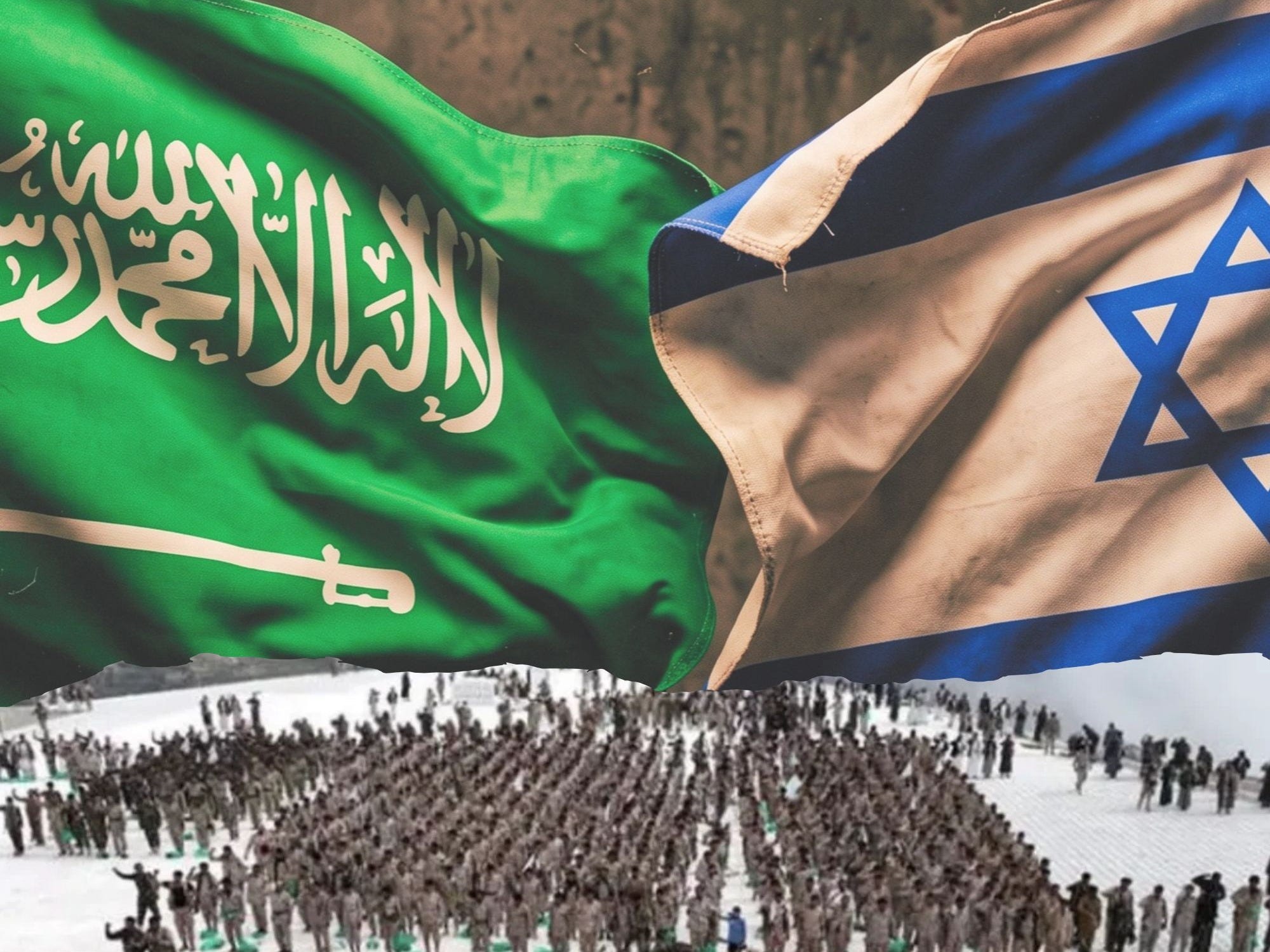
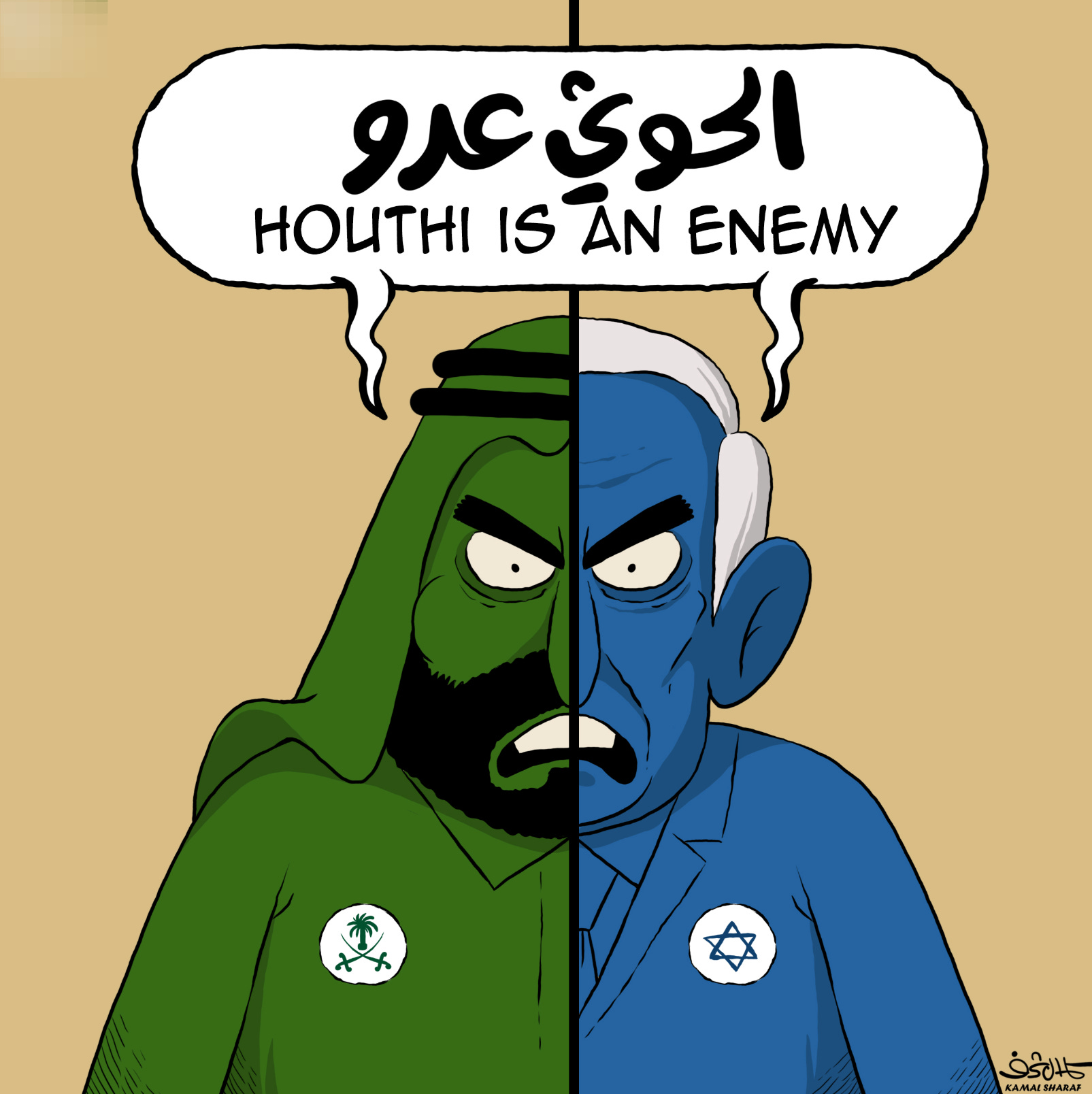
But reducing these operations to tactical bargaining chips misses the ideological campaign driving them. The movement’s Iran-backed leader, Abdulmalek al-Houthi, has been increasingly stating it publicly. During a long speech on September 21, in which he commemorated the anniversary of the Houthis’ takeover of Yemen’s capital twelve years ago, he told his followers that he does not consider Mecca a Saudi emirate and that the Saudi kingdom exploits the sanctity of the holy mosque “to impose influence that serves the American, the Israeli and the British.” He urged Muslims around the world to judge the Saudi ruler by “his ties to Zionist agendas,” juxtaposing this with Yemenis, whom he described as the bearers of an “authentic” faith and “more loyal to Mecca and more entitled to champion it.”
This explicit rejection of Saudi religious custodianship is built on the argument that an Islamic system allied with Washington and Israel cannot be trusted with Islam’s holiest cities. And while Saudi Arabia is clearly aligned with Washington, it does not have a formal relationship with Israel. In fact, the Houthis themselves could be seen as having a pragmatic view of the White House, as they have worked through an informal ceasefire to secure non-intervention by the United States.
Having questioned Riyadh’s right to guard the holy mosques, Abdulmalek has cast his own Houthi movement as their protector. On September 17, he told his followers that the Houthis are “the most ready to protect Mecca” and that “the Zionist plan is based on carving off Mecca and Medina” and offered to move “as an Islamic alliance” to stop it. The next day, the Houthis’ foreign ministry backed him up, declaring the clerics who preach from the Grand Mosque’s pulpit “not trustworthy over the holy sites.”
How the Houthis Weaponize Historical Grievance for Land Claimsdianship of Mecca, but reaches back to the formation of the Saudi state itself. Houthi leaders have been citing the Tanuma massacre of 1923 as a national trauma, when Ikhwan fighters allied with Ibn Saud attacked a caravan of Yemeni pilgrims in the Asir province on their way to Mecca, killing hundreds of worshippers. Yemenis recognize Tanuma but the Houthis made it theirs, turning the memory of this tragedy into a political and ideological pathos that drives their followers. In May, an op-ed in the Houthi state media drew a line from 1923 to the Saudi-led war that began in 2015, calling the blood of the pilgrims “a debt to be settled and a vengeance to be exacted.”
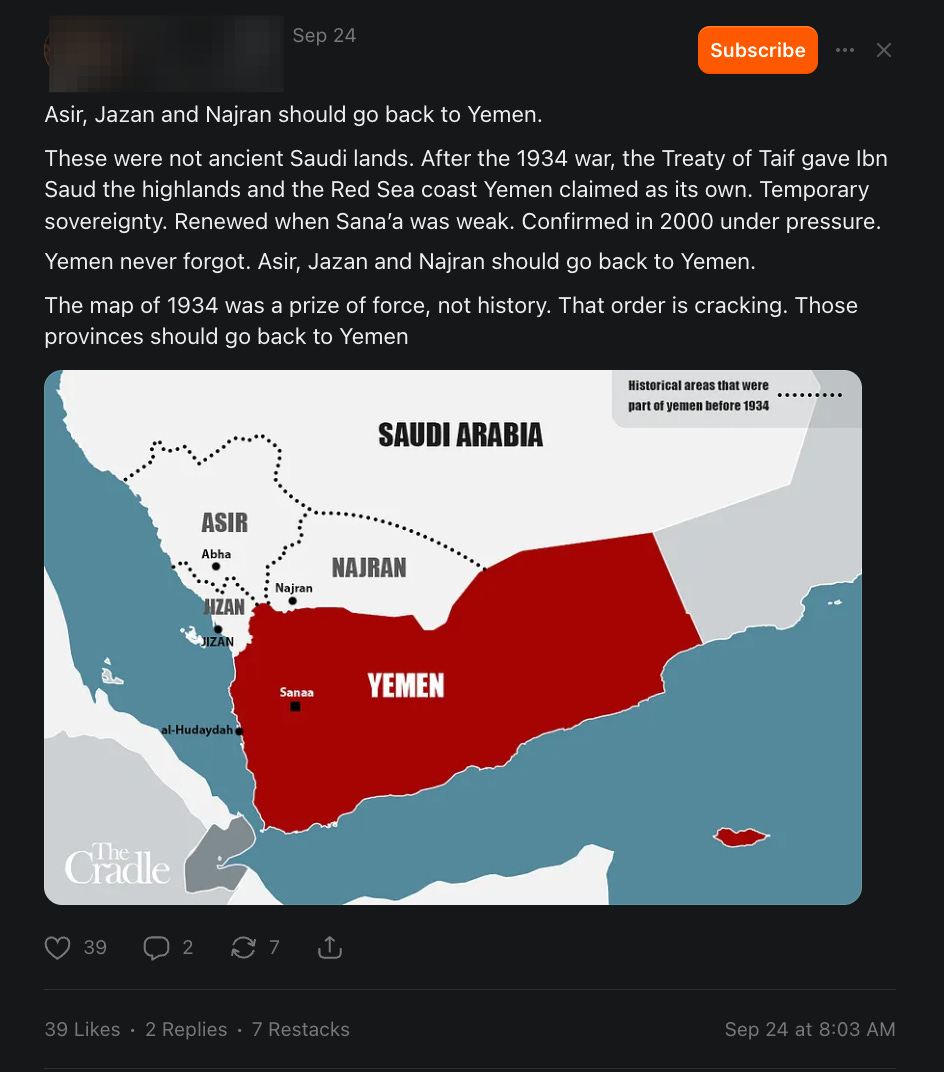
The Tanuma massacre, no matter how distant, serves as a Houthi claim on Asir—the place where it happened—and signals that the Houthis have no intention of recognizing any boundary between them and Saudi Arabia since Asir, alongside Jizan and Najran, lies in territory they insist belongs to Yemen. Houthis reject both the 1934 Taif Treaty and the 2000 Jeddah Treaty. In 2016, an article in a Houthi-aligned outlet argued that both treaties were void—signed under duress and authorized in violation of Yemen’s constitution—and that “what was taken by force is restored only by force.” This claim dismisses Yemen’s elected parliament, of course, which approved the treaty. The same article cited Houthi spokesman and chief negotiator Mohammed Abdulsalam saying that Yemen’s defense would include “control of the occupied Yemeni lands” that Riyadh used as a base.
This would not be the first time the Houthis challenged Saudi Arabia, as they crossed into Saudi territory in November 2009 through their seizure of Jabal al-Dukhan and two Saudi villages. By the time the fighting ended, Saudi Arabia had lost 133 of its soldiers. And while the Houthis are currently engaged in fighting with Yemen’s government forces and their Saudi backers, the army they built through their control over most of Yemen’s population and their mass mobilization gives them a ground force that could impose costs on nearby Saudi cities should they advance their ground war. Manpower is what makes these territorial claims more than rhetoric.
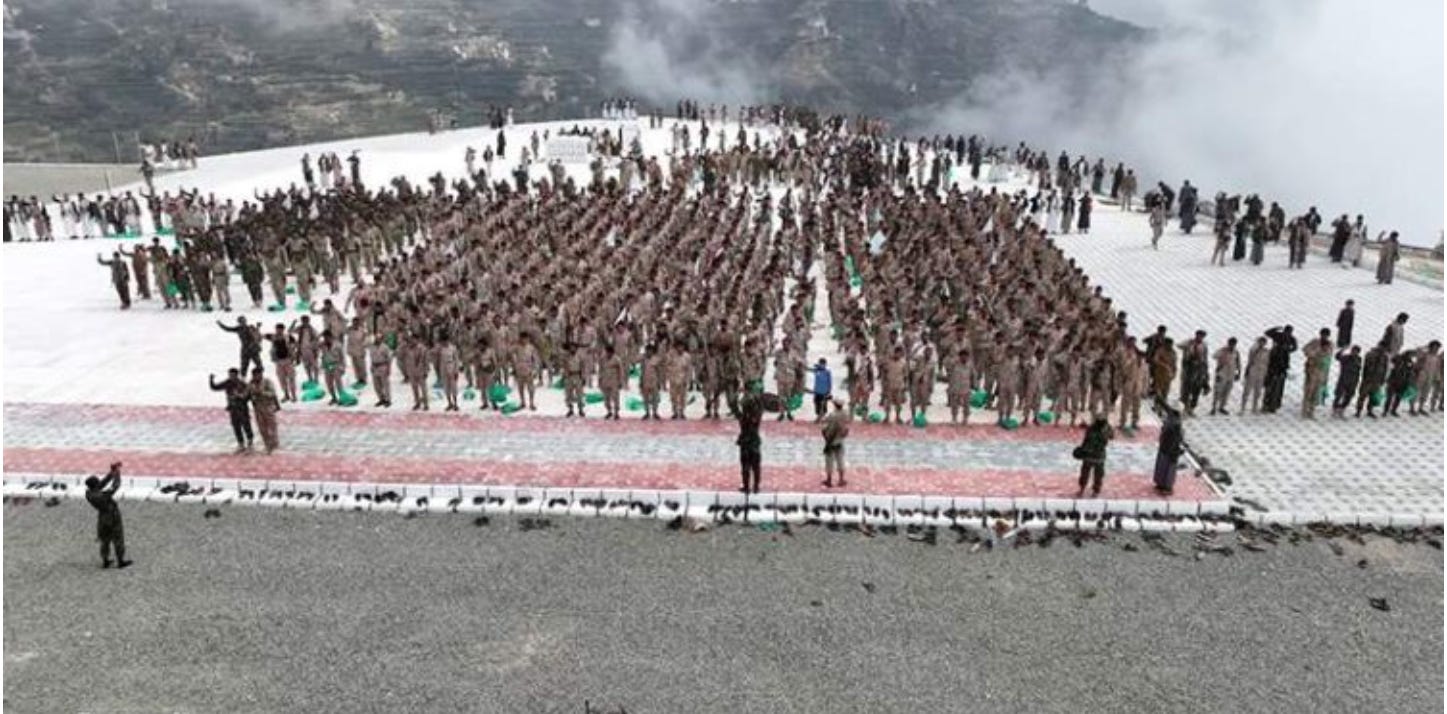
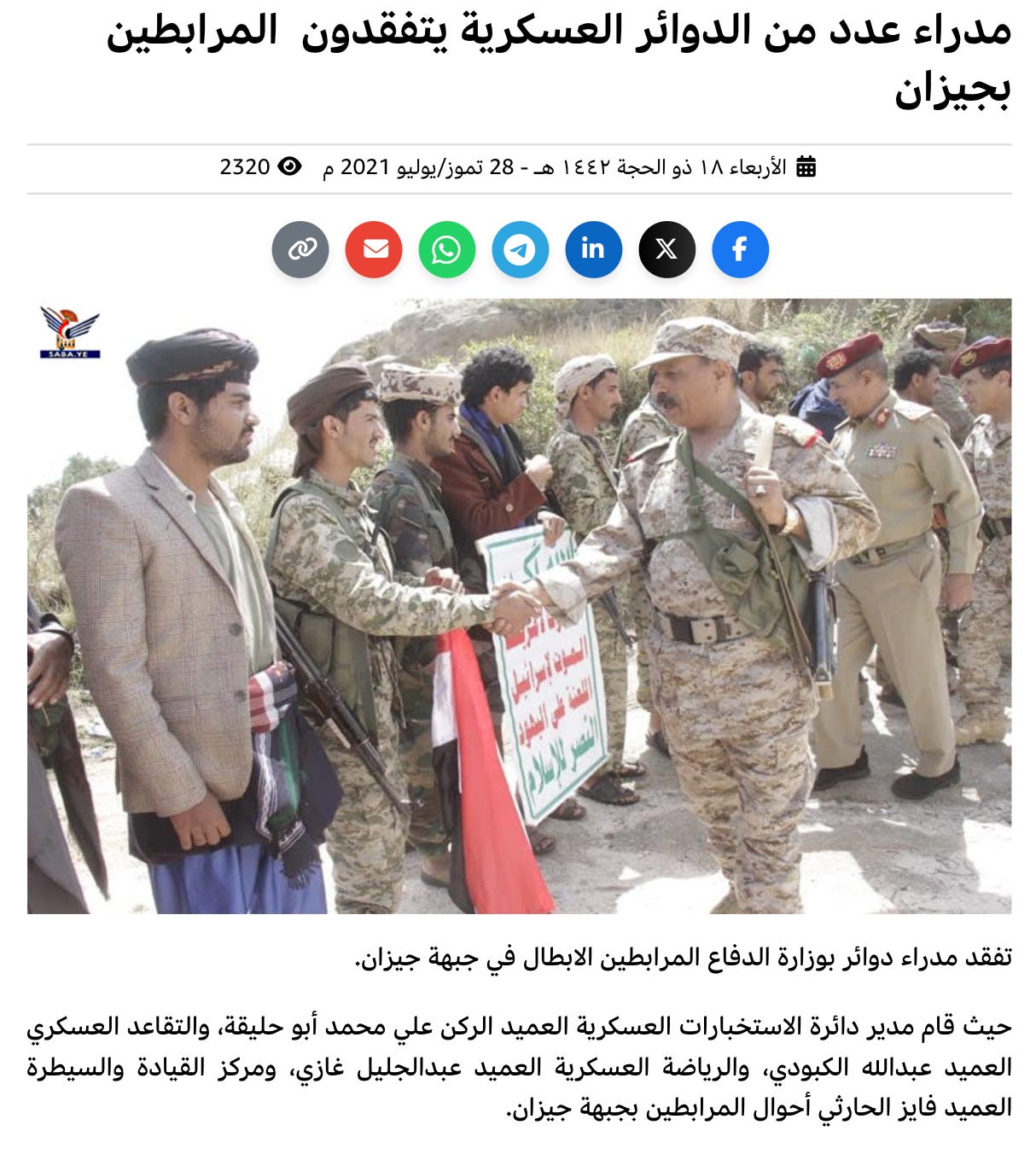
The Houthis have also written the claim into their army. Since 2021, Houthi media have replaced the name “Border Guard” with “Jizan Brigades” for the units holding the front from Harad in Hajjah into Saada, under Maj. Gen. Ahmed Yahya Jassar and his deputy, Col. Ali Abdullah Issa. When the Houthis’ defense ministry newspaper visited the “Jizan Brigades Group” that year, it reminded readers that Asir, Najran and Jizan are still “part of Yemen,” and boasted that Houthi forces in those sectors were moving closer to the Saudi interior every day and “threatening to bring down large Saudi cities.” In January 2025, hundreds of its fighters marched to Hussein al-Houthi’s shrine in Marran, where their comm
The Houthi challenge to Saudi legitimacy is increasing and does not stop at the kingdom’s present-day custoHussein al-Houthi’s shrine in Marran, Saada, after a march organized in January 2025. Photo: Al-Masirah.anders called the brigades a fruit of the Quranic project and told the movement’s enemies, “we are eager to confront you.”
Houthi supporters and sympathizers are now openly discussing the movement’s territorial ambitions. On social media, Western platforms included, people talk about a Houthi victory over Saudi Arabia and the Houthis taking Saudi land as if it were a normal political outcome, and nobody stops to point out how illegal, or how absurd, that is. Conquering another country’s territory by force is slowly becoming normal.
The Houthis’ Slow Strategy of Expansion
The Houthis protect themselves in the short term, but to achieve their vision, they only have to start somewhere, a little at a time. With the long-term vision in mind, Houthis pursue their objectives through ‘salami tactics,’ taking one slice at a time so that no single move seems worthy of a war.
Houthis applied this inside Yemen with their own tribal muscle, taking full control of Saada in 2011, forcing the Salafis out of Dammaj in January 2014, taking Amran that July, and capturing the crown jewel of Sanaa in September, by which point the capital fell almost as an afterthought. One detail that escapes many is how Hezbollah was integrated into the Houthis’ operations, because the evidence is often so hard to document. Hezbollah was in the room for much of this. In leaked footage released by the coalition, filmed during Ramadan in 2015, a Hezbollah trainer known as Abu Saleh reminds Houthi recruits how fighters were smuggled into Dammaj in water tankers and boasts of moving 350 fighters into an operations area. He then tells them he has “a special operation right in the heart of Riyadh,” which he calls a martyrdom operation, and refuses to say where or how, telling them, “you have no business with this matter.” The plan to bring the war into Saudi Arabia was already on the table back then.
Whether the Houthis can translate their claims into territorial gains depends not only on their military capabilities but on the opportunities available to them. The Houthis’ strategy has always been as much opportunistic as it is expansionist, and their ability to apply pressure and isolate their opponents has often translated into territorial gains when the balance shifts in their favor. That’s why attrition has always been the Houthis’ game. Each round of pressure raises the ceiling of what they can demand. Six rounds of war with Yemen’s government between 2004 and 2010 and years of war and talks with Saudi Arabia between 2015 and 2022 won Houthis the concessions they needed to keep expanding their demands.
The Houthi strategy has always worked on two levels: In the short to medium term, they apply enough pressure that Riyadh could assume that abandoning its partners in Yemen costs less than a fight over its own territory and standing. Such a retreat would undoubtedly entrench the Houthis as Yemen’s de facto rulers, or reignite the civil war. Each concession would win the Houthis another slice of territorial control and political power that Saudi Arabia would find costly to overturn in the future.
For now, the danger to Saudi Arabia is a slower campaign in which repeated border incursions, territorial claims on Asir, Najran, and Jizan, and political subversion become accepted features of the conflict. The Houthis, who have a tendency to obfuscate so loudly and capture the global imagination by portraying themselves as part not just of the Axis of Resistance but of an anti-imperialist system, are becoming increasingly confident in their ability to achieve their regional ambitions.
The blueprint for what the Houthis envision for Riyadh can be seen in the fate of Ali Abdullah Saleh. The Houthis entered Sanaa in 2014 with the help of Saleh’s entrenched state apparatus, which they gradually turned to their own advantage. For three years, Houthis hollowed out his power base from within—until December 2017, when Saleh attempted to break away and reconcile with Riyadh. The Houthis killed Saleh days later as he tried to flee Sanaa, and absorbed much of the military and bureaucratic machinery he had commanded.
And now, that same co-optation strategy is being directed across the northern border. Houthi Political Bureau member Mohammed al-Bukhaiti explicitly offered the movement’s cooperation with any popular revolt, the Saudi Islamist opposition (Al-Sahwa al-Islamiyya), or even members of the House of Saud willing to depose Crown Prince Mohammed bin Salman. Al-Bukhaiti went further, claiming that Saudi Arabia’s infrastructure, oil wealth, and Hajj revenues belong not to the state, but to the “Land of the Two Holy Mosques,” arguing that military strikes ensure MBS can no longer wage war from a position of domestic safety. And so the Houthis are dangling tactical cooperation with domestic rivals to crack the Saudi state from within, exploiting its internal fault lines. Any royal tempted by the offer should remember that Saleh, too, was a partner until he wasn’t.
The Iranian Roots of Houthi Claims
The Houthis’ view of the Saudis as unworthy guardians of the holy mosques has a clear precedent in Ruhollah Khomeini, the founder of the Islamic Republic. Khomeini had often stated that the Hajj pilgrimage carries a political duty alongside its spiritual one and built that view into the Islamic Republic’s revolutionary program. Khomeini drew on a Quranic verse that proclaims God’s break with the idolaters on the day of the pilgrimage and instituted a ritual he called the “disavowal of the polytheists.” He identified the polytheists as the United States and Israel. Under Khomeini, Iran’s pilgrimage delegation organized annual rallies in Mecca during the Hajj in which Iranian pilgrims chanted, “Death to America, death to Israel!” Saudi authorities, however, barred political demonstrations at the Hajj and restricted the rallies. In July 1987, one such rally ended in clashes with Saudi police, leaving some 400 dead.
It was no surprise, then, that the Houthi movement founder Hussein al-Houthi, who came from Yemen’s Zaydi tradition rather than Iran’s Twelver Shiism, was articulating Khomeini’s views. By 2002 he adopted much of Khomeini’s revolutionary vocabulary and called the pilgrimage an act of worship “that the Al Saud disabled.” Most revealing as well is that a year after the 2015 Mina crush, in which more than 2,000 pilgrims died by some counts, Ali Khamenei’s Hajj message urged the Muslim world to “fundamentally reconsider the management of the two holy places.” At the same time, the Houthi-aligned Yemen Scholars Association declared that “the Kaaba is God’s house and not the house of Al Saud.” This pressure on Saudi Arabia and focus on its legitimacy continued year after year and became part of the movement’s ethos.
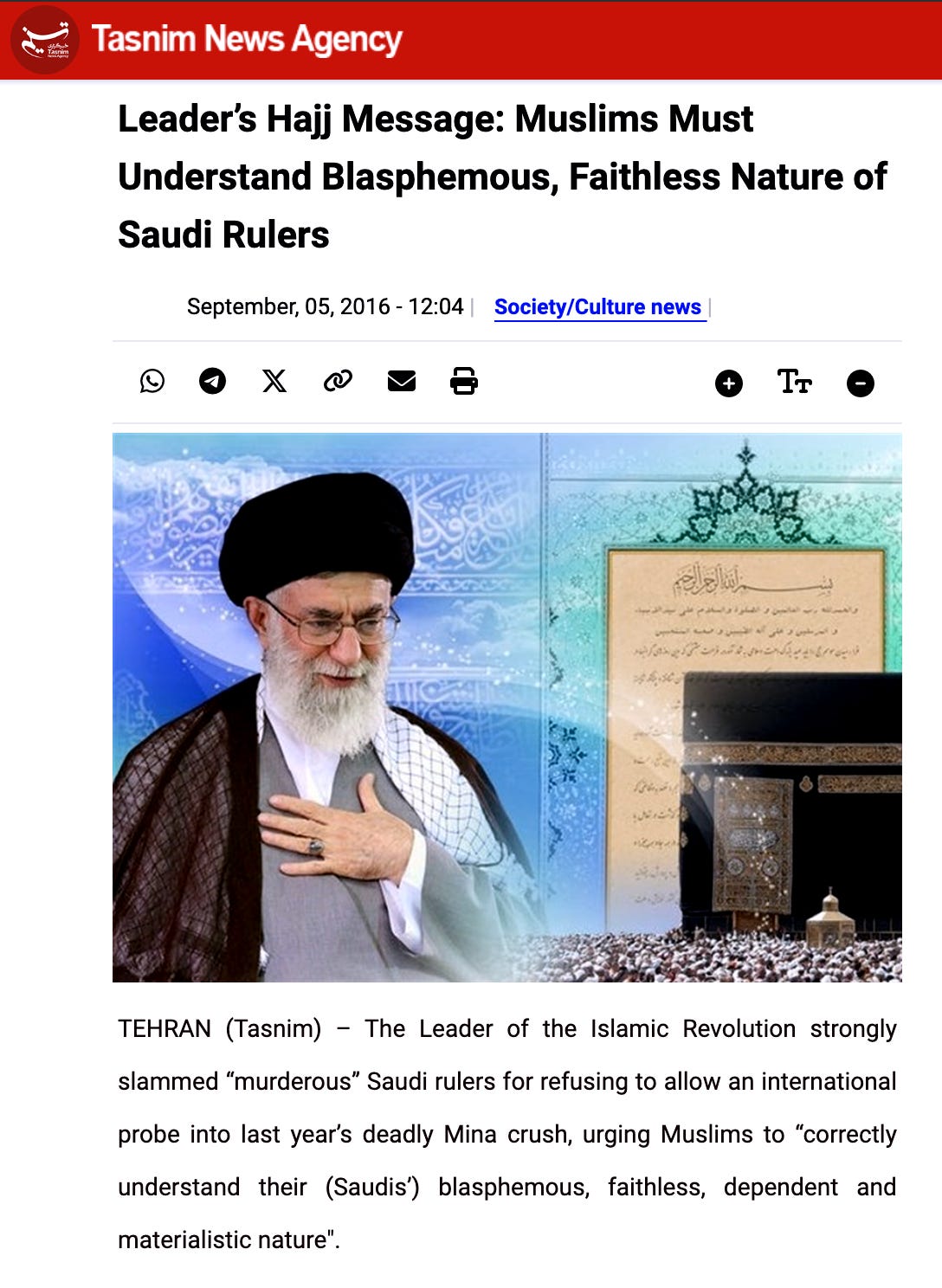
Despite a Khomeinist culture of challenging the Saudis, Tehran was keen to preserve its 2023 rapprochement with Riyadh under the Beijing agreement, and in May 2025 Foreign Minister Abbas Araghchi condemned an Iranian cleric who mocked the kingdom’s “casinos, brothels and obscene concerts.” Naturally, the pretense of diplomatic courtesy faded during the war on Iran, as the kingdom expelled Iran’s military attaché after Iranian strikes on Prince Sultan Air Base south of Riyadh, and that’s when Tehran let its clerics loose on the Saudis. In September, the Friday prayer leader of Ardabil was amplifying the Houthis’ own case against Saudi custodianship, praising their response to Riyadh that the Saudis had insulted the Kaaba by giving a piece of its covering to Jeffrey Epstein “to be put under the feet of adulterers.”
Oil is the other prize. When the Gaza war began, Khamenei urged Muslim states to cut off oil to Israel, and the Gulf refused, with the GCC’s secretary-general saying oil would not be used as a weapon. Abdulmalek has made his own version of the complaint, accusing Riyadh of keeping Yemenis from their oil wealth while tying the region’s money to Washington and, through normalization, to Israel. Since July, the Houthis have stopped waiting for Riyadh to use its oil and started using it themselves, declaring a naval blockade on Saudi exports. Control over Yemen’s oil fields, and leverage over Saudi Arabia’s, would hand the Houthis and Tehran the oil weapon the Gulf refused to wield.
Riyadh’s Dilemma: A Deal That Settles Nothing
While it is easy to dismiss Abdulmalek’s claim on Mecca as sheer bluster, it’s useful to remember that the Houthis, with their humble beginnings in the mountains of Marran, have been consistently clear about where they are heading since 2004.
Even where Riyadh sees the threat, responding to it is the harder problem. There might be some internalized awareness of the Houthis’ long-term aims, given Saudi Arabia’s pursuit of an alliance through the Mecca Pact, or even Egypt’s approval on Sunday of a defensive troop mission to the Kingdom, which is now before its parliament.
But just because the Houthis have articulated their ambitions does not necessarily mean they have the military capacity to realize them right away. Their strategy has never depended entirely on conventional military superiority, but rather on attrition, political fragmentation, terrorism, and propaganda, exploiting opportunities whenever regional circumstances worked in their favor. The IRGC exploited a similar pattern during the Arab Spring, taking advantage of political upheaval and the collapse of state institutions to strengthen its influence across the region. The Houthis have also learned to exploit regional crises and saw a surge in their popularity across the world after their attacks on Israel.
Meanwhile, the Houthi threat continues through their hold on territory in Yemen and their access to the sea, which lets them obtain the components to build their own weapons. With that manufacturing capacity, the danger lies in what AI and robotics could give them to compensate for their conventional military disadvantages. And while the Houthis’ ambitions may seem beyond reach today, the political circumstances and military technologies that determine what they can accomplish are unlikely to remain the same indefinitely.
The Road to Jerusalem
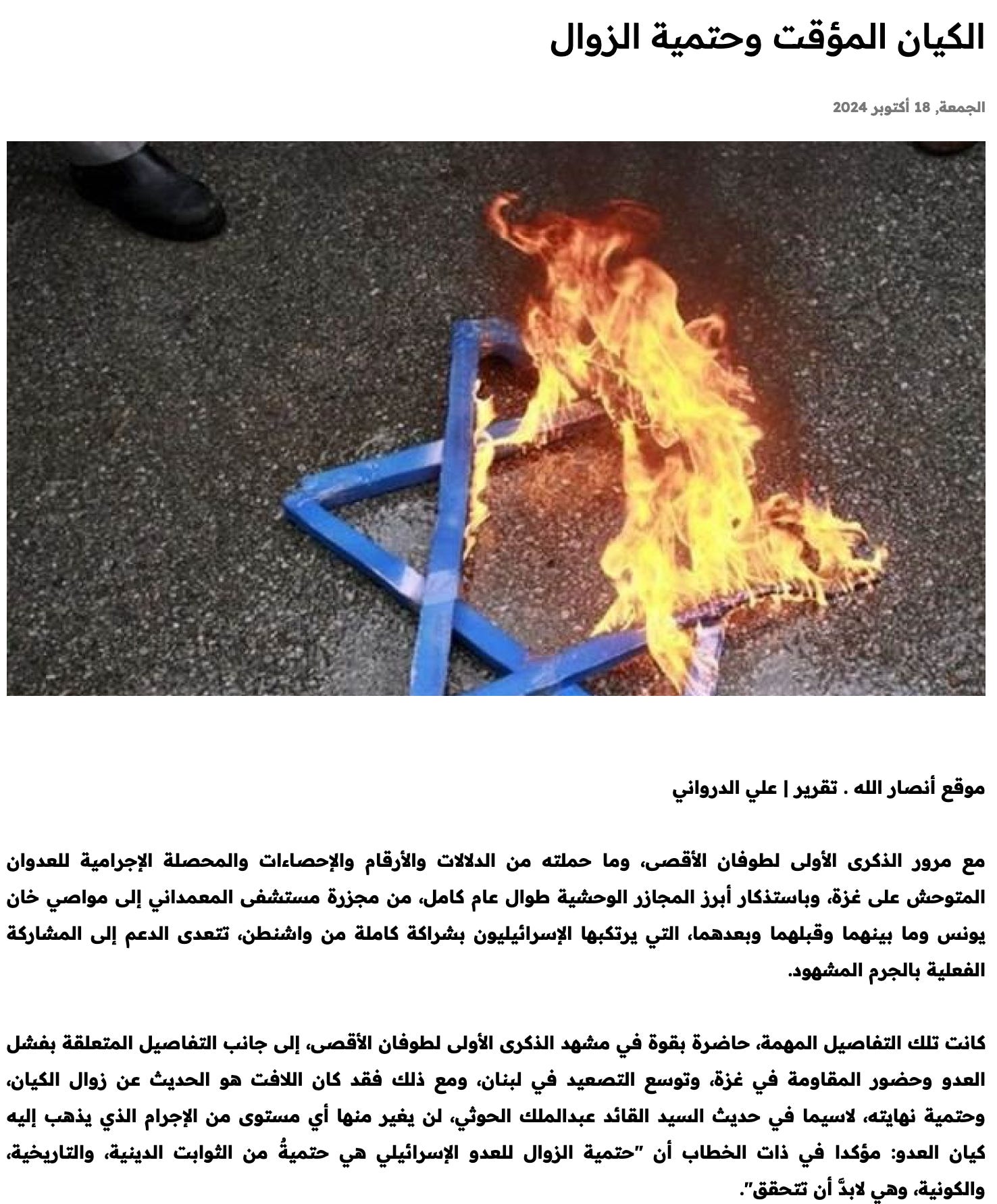
Mecca is only half of the Houthis’ map. In the Houthis’ vocabulary, Israel is “a temporary entity,” and Abdulmalek has called its demise an “inevitability among the religious, historical and cosmic constants.” Abdulmalek has continued to lash out at Saudi Arabia’s relationship with Israel, which he sees as absolute. In fact, while he denies any type of command and control between his movement and Tehran, he speaks with full confidence on the Saudis’ relationship with Israel and describes Saudis as Zionists. Al-Houthi accused Riyadh of intercepting drones heading to Israel and opening its airports to Israeli reconnaissance aircraft, which in the eyes of the Houthis turns the kingdom into the gatekeeper between them and Jerusalem.
Iran’s wartime slogan states that the road to Jerusalem passes through Karbala and from the southern end of the Arabian Peninsula, the Houthis would have it pass through Mecca. For Riyadh, which has exhausted its options in dealing with the Houthis, the problem lies in dealing with an adversary whose military objectives are relatively limited yet wrapped up in political claims that are almost impossible to strike a deal over.
For revolutionary movements that regard existing borders as historical injustices and established governments as illegitimate, territorial sovereignty is not a principle to uphold but an obstacle to overcome. For the Houthis, as for Khomeini and Khamenei, Mecca matters most as the place from which the Muslim world could be called to Jerusalem, and the Saudis are the ones standing at the gate.
Additional Sources