

This is an excerpt of an article that I published in The Stimson Center, Middle East Program. The full article can be found here.
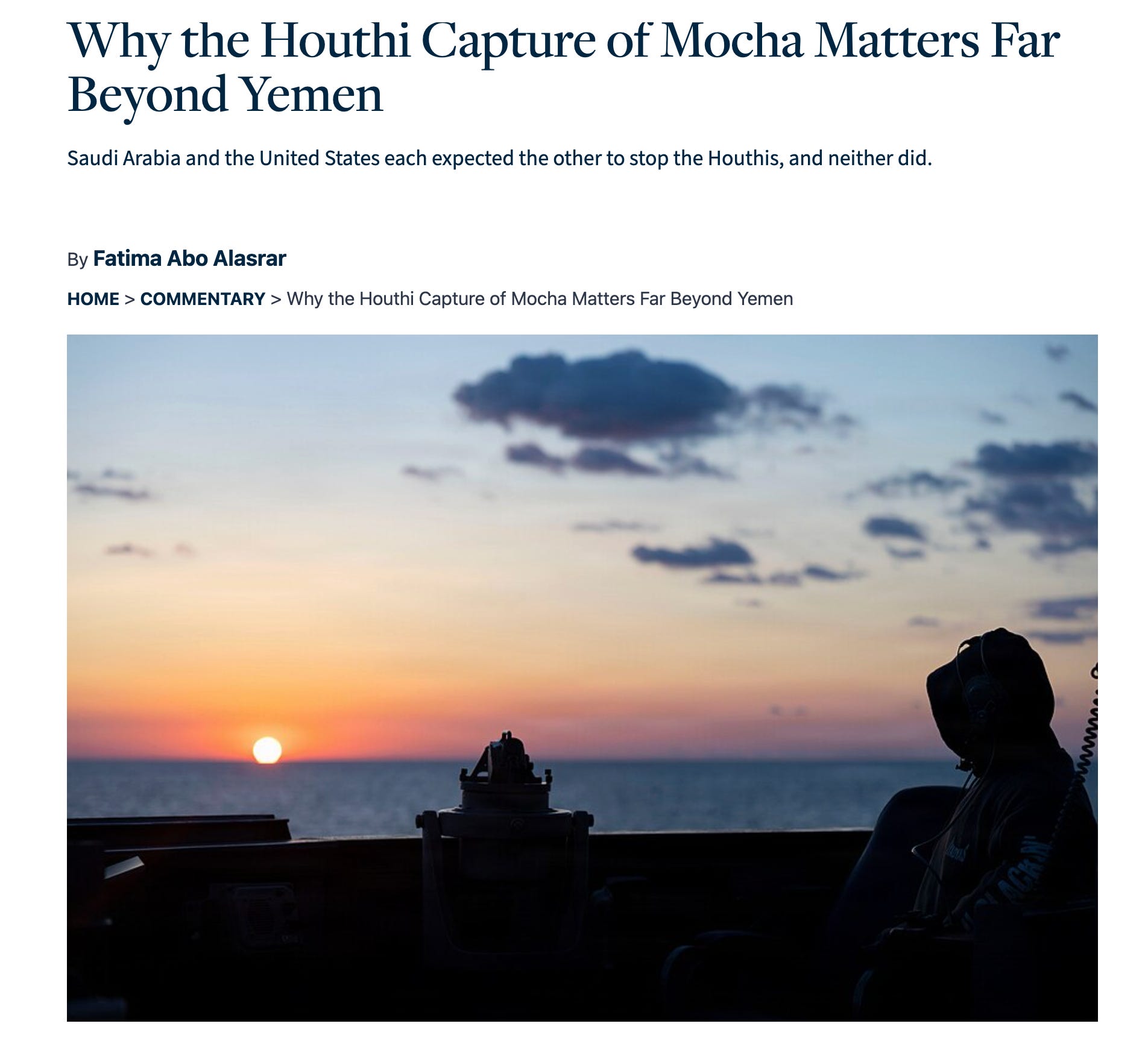
In their most ambitious ground offensive in years, the Houthi militia has captured the port of Mocha and nearby islands to cement their control over Bab al-Mandab, the narrow corridor connecting the Red Sea to the Gulf of Aden. The move puts pressure on commerce through the Red Sea as the broader war with Iran has already choked traffic through the Strait of Hormuz.
This kind of escalation was not unexpected. But the U.S. decision to go to war with Iran in February was the catalyst, opening a Pandora’s box whose consequences are now playing out across the region. Before that, the Iran-backed Houthis had limited their attacks on Saudi Arabia under a Saudi-Iran agreement and had limited internal expansion under informal understandings after a 2022 UN-brokered truce collapsed. But all these agreements crumbled after the funeral of Ayatollah Ali Khamenei in June and the Saudi decision, with political support from the Trump administration, to target Sanaa airport to prevent the landing of an Iranian plane carrying the Houthi delegation that had attended the funeral. The Houthis responded by firing missiles at Saudi territory, and a week later, they began launching attacks on Saudi-linked tankers in the Red Sea.
The escalation follows the Trump administration’s decision to try to further constrict the Iranian economy through a naval blockade and new sanctions that Washington has dubbed Operation Economic Outcast. Iran had warned more than once that Washington would pay a price at Bab al-Mandab for refusing to acknowledge Iranian authority in Hormuz; the week before the offensive, Iran told the Houthis to step up their attacks on Saudi Arabia, promising more money, weapons, and personnel, according to Iranian sources cited by Reuters.
Senior commanders from the Islamic Revolutionary Guards Corps (IRGC) were already in Yemen, helping direct the push down the coast. Iran’s parliament speaker, Mohammad Bagher Ghalibaf, was quick to celebrate the September 10 fall of Mocha, writing the same day that the Yemeni people would “certainly prevail.” Tehran claims that the decision to take Mocha was solely the Houthis’ while acknowledging that the offensive served Iran by boosting oil prices and adding to the political costs of the war on both Washington and Riyadh.
Strategically, the timing made sense for the Houthis and Iran as four developments turned a long-held Houthi ambition into an opportunity.
The first is that the crisis at Hormuz had lost some of its edge. Traffic through the strait had collapsed to a trickle, but the market panic had subsided somewhat as the international community adapted and found alternate routes to circumvent the strait. Signals from the Trump administration about ending the war also affected the markets. In early August, talk of a deal to reopen the strait was enough to push Brent down to about $80 a barrel. When the U.S. then intensified sanctions, the leadership in Tehran realized that squeezing Hormuz was not enough to force an end to the war.
Second, the closure of Hormuz made the Red Sea Saudi Arabia’s principal alternative export route, increasing the appeal of the Bab al-Mandab to showcase Iranian leverage via the Houthis.
The week that Mocha fell was telling. In the space of three days, Washington destroyed five Iranian tankers, Iran claimed strikes on 10 vessels near Hormuz, and the Houthis took Mocha. Taken one at a time, these look like naval tit-for-tats. Taken together, they constitute a single response executed across two chokepoints. Of the two economic wars underway, Iran’s is arguably the better designed at least for now.
Third, Saudi Arabia’s consolidation of the anti-Houthi camp had given the internationally recognized Yemeni government new confidence. The South is now under a single Saudi-backed command structure, a shift I wrote about for Stimson earlier this year. But rather than waiting to see if this reorganization would translate into actual military strength, the Houthis preempted it. They pushed down the coast to shatter the government’s new defensive posture before it could alter the balance of power.
Finally, the Houthis had been preparing for this advance not just by holding back the firepower they used sparingly at the onset of the Iran-US war, but also through manpower as the movement has been running mobilization campaigns in every governorate it controls. Frequent parades put uniformed fighters on display nationwide. Tareq Saleh’s National Resistance Forces, among the best-armed formations in the anti-Houthi camp, had held Mocha for nearly a decade, yet it changed hands within hours with barely a fight. (Saleh is the nephew of Ali Abdullah Saleh, a longtime former president who allied with the Houthis in 2015 but switched sides in 2017 and was subsequently killed by a Houthi sniper.)
That the defense of Mocha was that thin was not an accident. Saudi Arabia and the United States each expected the other to stop the Houthis, and neither did. As the Houthis closed in on Mocha, reports emerged that Saudi Crown Prince Mohammed bin Salman called President Trump twice to press for a U.S. attack. However, American forces, Trump officials told the Saudis, would stay focused on Iran and Hormuz. By the time Saudi jets struck on their own, the city had already fallen.
To read the rest of the article, please visit the following link.