Why Saudi Arabia Went to Tehran Anyway
Riyadh’s presence at Ali Khamenei’s funeral is not what it seems.
“Saudi rulers... are disgraced and misguided people who think their survival on the throne of oppression is dependent on defending the arrogant powers of the world, on alliances with Zionism and the U.S.”
— Ali Khamenei, 2016
This week, those rulers came to his funeral.
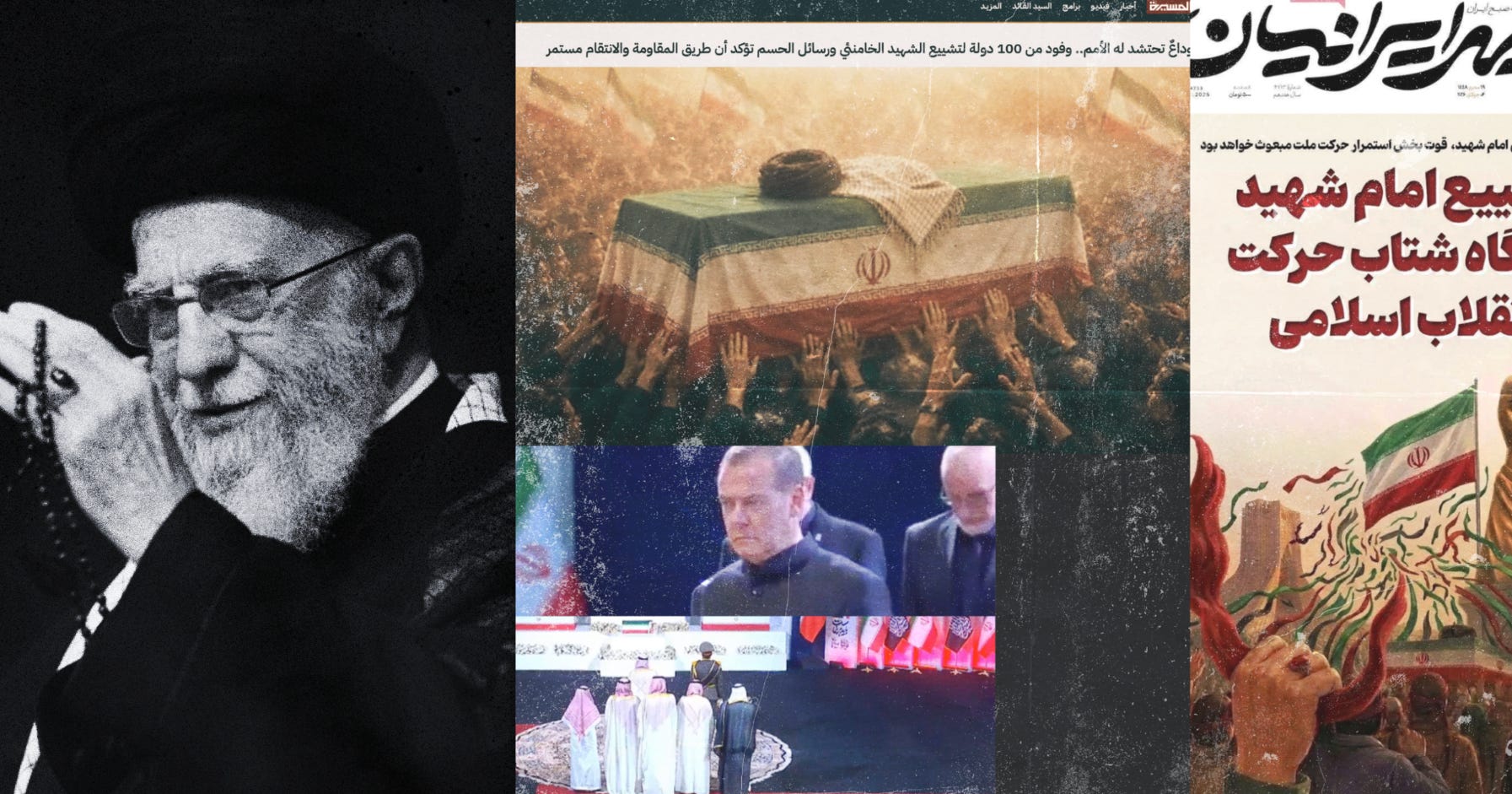
The sea of black-clad mourners and predictable dignitaries filling the funeral procession in Tehran today for Ali Khamenei offered few surprises. The usual cast of regional proxies and traditional Iran allies gathered to pay their respects to Ali Khamenei, who was killed on the first day of the US-Israel war on Iran. So did dozens of other countries, from Russia and China to India, Malaysia, and Tunisia, a roster that cut across religion and ideology alike. Yet what forced the double take was the presence of a mid-tier Saudi Arabian delegation, headed by Deputy Foreign Minister Waleed El Khereiji. After months of watching Saudi Arabia get battered by the IRGC establishment during the war on Iran, seeing Saudi officials navigate a crowd that included the very militant leaders who have targeted their infrastructure was surreal. It was also a reminder of how much realpolitik drives Riyadh’s calculation with Iran. Whatever it looked like, it was a transaction, not a thaw, and mistaking the presence for partnership puts the region exactly backward.
The optics are difficult for a Saudi Kingdom that keeps reaching for de-escalation and keeps being handed something else. For the first hours, Saudi coverage carried the funeral procession but there was no coverage of its own delegation standing in it. Tehran chose a Quranic verse for each delegation as it approached the casket. The Houthis got a verse praising those who stand with the Prophet, severe against disbelievers, merciful among themselves. The Russians, represented by Dmitry Medvedev, the former Russian president, got a verse on those who "do not desire exaltedness upon the earth," an ironic fit for a power waging a war of territorial expansion.
The Saudis, however, got a verse that placed the Kingdom among the disbelievers. Khamenei's contempt for the Saudi monarchy was lifelong and personal. Tehran knew Riyadh would read it exactly as intended. Pro-Axis accounts online were already praising the choice as proof of Tehran's command of scripture as a messaging tool.

None of this is lost on Riyadh. The Saudis know exactly where they sit in this equation, close enough to the fire to have been burned by it already, and they came anyway. It is what a state does when it has read the board correctly and does not like what it sees.
For nearly a decade, Saudi Arabia fought Iran’s chief proxy in Yemen largely alone, with little Western help and no guarantee anyone would come if things worsened. The lesson took hold. Riyadh learned to handle Iran itself, which is what it did in March 2023, when it restored relations with Tehran, its chief rival, in a deal brokered in Beijing. Washington was not in the room. It was détente built on wariness, not warmth, and it held for as long as it could, until the United States intervened. The war Washington fought across the Red Sea and the Strait of Hormuz has left consequences that keep falling on the region and its people, and it produced the opposite of what it intended. It cemented an image of power for Iran and its proxies rather than breaking it.
The Saudis are watching all of this closely and working to limit the risk Iran and its proxies still pose, including, it appears, trying to keep the Houthi delegation from reaching Tehran for the same event. Even as Riyadh’s envoys were paying their condolences, Saudi and Houthi forces were reportedly clashing in the air over Yemen. The Iran-backed Houthis said Saudi warplanes had tried to intercept an Iranian flight carrying their political leadership to the same funeral, and warned they would answer any further violation of their airspace. Within hours, the Saudi-led Coalition responded, vowing to meet any attempt against the Kingdom, its citizens, or its national assets “with unprecedented determination and force.”
The Houthis put their chief military spokesman forward to answer a routine interception, a heavy response to a flight they called humanitarian. What’s reassuring here, especially for anyone who thought Riyadh was quick to normalize with the IRGC, is that Saudi Arabia is still at work behind the scenes to limit the Iran-backed Houthis’ influence around its border and, ultimately, on the Red Sea. Riyadh has learned not to take the humanitarian label at face value, because the group moves weapons as a matter of survival, and its airspace is where that traffic runs. So a high-profile funeral is exactly the kind of moment its supply needs cover. None of this requires knowing what was on the plane, only knowing how the Houthis operate.
Last month the United States signed the Islamabad Memorandum of Understanding with the Iranian regime, a bilateral deal that, as I argued when it was signed, undid nearly every objective the war was fought to secure. It also left the Gulf’s security exactly where it found it. Through its proxies, the Gulf has been the most exposed party in this war, and the American guarantee has never looked thinner than it did under this round of fire. Washington reached a framework with Tehran faster than Saudi Arabia has been able to end its ten-year war of attrition with the Iran-backed Houthis. Tehran's own military leadership turned the funeral into a deterrence platform. According to the Houthi outlet Al-Masirah, Iran's army chief, its IRGC commander, its deputy defense minister, and the commander of the IRGC Aerospace Force each vowed on the day of the ceremony that the leader's blood and any breach of the ceasefire would be avenged.

For the Gulf, the memorandum was a bitter pill to swallow. It could not address the threat that actually bears on them, the proxies, the missiles, the drones, and Washington gave little sign of wanting to. That was clearest when the deal granted Iran, like any state, the right to defend itself, the very capability the war was launched to strip away. A state watching its guarantor define the danger this narrowly learns to define it for itself. The attendance of the funeral procession runs on that lesson. Accept a framework you did not write, and keep managing the threats it leaves out.
That is what the delegation in Tehran and the interception over Yemeni airspace amount to, one posture, not two. Riyadh takes the Iran-Houthi threat seriously enough to work every register it has, managing Iran itself because it has stopped assuming Washington will. Of everyone in that room, the Saudis have fought the most recent war with an Iranian proxy and hold the fewest illusions about the relationship with Tehran. Whatever restraint was on display was tactical, the behavior of a state that has read the board, remembers what the last round cost, and trusts no one else to keep the account. What matters is not who stood beside the casket. It is who holds the ground when the talking resumes.


