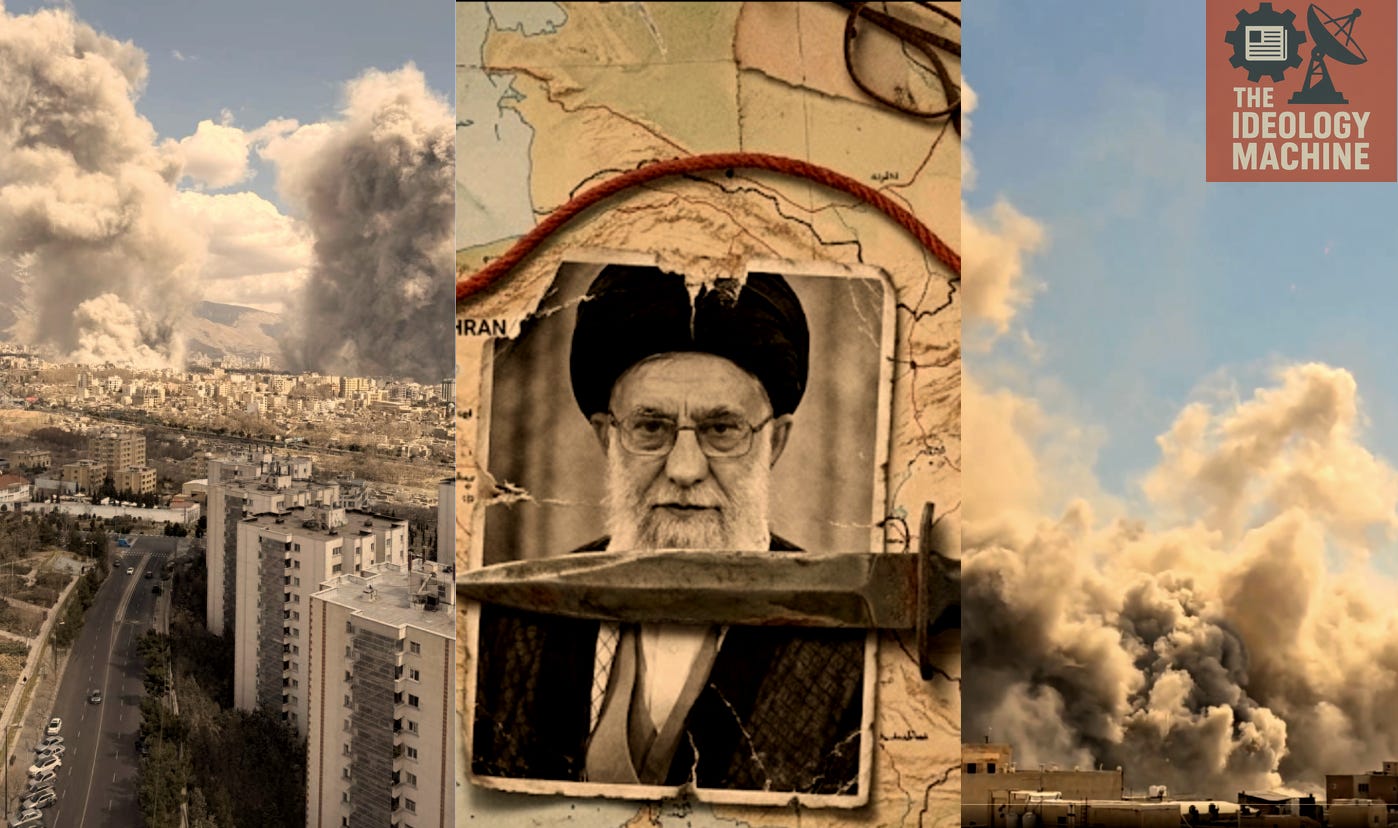
Khamenei Killed in Tehran, What Happens to Iran's Proxy Network Now?
Ali Khamenei is dead and his command structure with him. But the system he built is still running, and no one in Washington is clear on what comes next.

If you are watching what happened this weekend and processing it through the lens of “is this another Iraq?” or “are we being dragged into another Middle Eastern conflict?”, that skepticism is legitimate. The United States has done this before, launched operations in this region that were tactically impressive and strategically aimless, and taken out individuals without ever addressing the conditions that produced them. And the question people are asking, “and then what?”, is not defeatist. It is probably the most important question in strategy right now, and those asking it deserve an honest answer.
But skepticism should be informed by what is actually in front of us, not by pattern-matching to wars that looked nothing like this. What happened this weekend is not an invasion, or an occupation, or a war premised on fabricated intelligence, but rather a strike, dubbed Operation Epic Fury by the Pentagon and Operation Roaring Lion by Israel, against a regime that, for over four decades, built and directed a network of armed proxies that killed Americans, destabilized sovereign nations, hijacked international shipping, and pursued a nuclear weapons capability while negotiating in bad faith to preserve it. Three American service members are dead today from Iranian missiles, and thus, this is not theoretical.
And Khamenei was an 86-year-old man. He had ruled Iran for thirty-six years, longer than most of the people reading this have been paying attention to the Middle East. His death was always coming, and the system he built was always going to have to outlive him. What is consequential is not that he is gone but how he went: not quietly, not through succession planning on Tehran’s terms, but in a strike that no one in the axis believed would happen at this scale. Because Khamenei did not merely lead the Islamic Republic. He made it replicable. He built something that functions less like a government and more like an operating system, one that served not just Iranian interests but an emerging order designed to compete with American power: ideology as infrastructure, proxy networks as force projection, and a media architecture capable of synchronizing narratives across Arabic, Farsi, Russian, and Chinese ecosystems within hours. The system was designed to survive him. And in the first twenty-four hours, it did.
The axis had been preparing for a post-Khamenei world for years, although not necessarily this version of it. In the weeks leading up to the strike, Iranian, Houthi, and Russian state media were growing increasingly confident that American deterrence was a bluff, that the strike wasn’t coming, and that diplomacy would prevail. That confidence was wrong. However, the system doesn’t plan for one outcome, it builds contingencies, and the Provisional Leadership Council that formed within hours, with hardline judiciary chief Gholamhossein Mohseni Ejei and President Pezeshkian assuming temporary leadership duties, was not improvisation but Article 111 of the constitution executing as designed. The question worth watching is whether the axis always viewed Khamenei as replaceable within the architecture he built, and whether this moment, for all its violence, is one the system had already rehearsed.
Several things are true at the same time.
Israel’s reach was extraordinary. A joint U.S.-Israeli operation killed the Supreme Leader in his compound in Tehran, along with IRGC commander Mohammad Pakpour, Defense Minister Amir Nasirzadeh, and Armed Forces Chief of Staff Abdolrahim Mousavi. The fact that they located him, got to him, and took out that much of the command structure in a single operation is something the resistance axis genuinely did not think was possible.
The chaos Iran is unleashing in response is real but limited. Six waves of retaliatory strikes under “True Promise 4.” Missiles at Israel, at the UAE, at Qatar, Bahrain, Kuwait, Saudi Arabia, Jordan. Three American troops killed. Fires at Jebel Ali port and the Burj Al Arab. It sounds like a region on fire, and parts of it are. But most of the missiles were intercepted. The Strait of Hormuz threat is oscillating. And the retaliation, for all its fury, is running on a pre-programmed escalation ladder, one that was designed to execute without the leadership that just died. The IRGC is firing on pre-authorized commands, protecting its own survival. That is the system working as designed. It is not the same as a system that knows what comes next.
And the axis, the network of proxies and allies that Khamenei spent decades building, was not prepared for this, although they believed they were. For months, axis leaders appeared on television in military uniforms, held press conferences, and issued statements about readiness and resilience. Moscow and Beijing reinforced the message, projecting through state media and diplomatic channels that the American calculus would never go this far. The deterrence posture was real, and for a time it worked. The 12-day war in June 2025 was the reference point: a limited exchange with defined boundaries that everyone survived. The axis calibrated for a repeat of that pattern, and the psychological shock of discovering otherwise is, in strategic terms, as significant as the strike itself.
Moscow's response has been instructive. Putin called the killing a "cynical murder" and praised Khamenei as an "outstanding statesman," while Russian state media had spent weeks assuring its audience that Washington lacked the will to act. RT echoed Iran's framing of the December protests as foreign-backed riots, and helped build the narrative that deterrence was holding. It wasn't. RIA Novosti columnist Dmitry Savchuk argued the threat was a pricing instrument, not a war plan, reading it from commodity futures rather than military signals. Petr Akopov wrote that Trump 'doesn't want to open Pandora's box.' Victoria Nikiforova framed the entire Iran escalation as 'world war in a light format,' a forcing function for tighter axis coordination, not an actual countdown to strikes. The consensus position in Russian state media as late as the week before the operation was that American deterrence was a bluff, or rather limited.
By Sunday, a Russian columnist in RIA Novosti had already recast Khamenei's death as a strategic act, martyrdom by design, succession pre-arranged, Trump handed an off-ramp. Even in death, the system found a use for him. And Russian analysts are already saying the quiet part out loud: regime change in Iran would almost certainly produce a government that is distrustful of or openly hostile to Moscow, and Russia's position in the Caucasus, Central Asia, and the Caspian is now exposed. If Russia could not deter the United States from killing its most important regional partner, the value of a Russian security guarantee just got a lot harder to sell.
Over the past two years, it became almost routine to watch Israel and the United States take out militia commanders, proxy leaders, and even senior Hezbollah figures like Nasrallah, and the resistance axis absorbed those losses and kept operating. But killing the Supreme Leader of a sovereign state, however illegitimate its origins in a revolution no one asked for, is categorically different, and the scramble that followed shows it. Hezbollah escalated from solidarity to operational commitment language but hasn’t fired a shot across the border. Iraqi militias stormed toward the Green Zone and struck Erbil, the only node that actually went kinetic. And the Houthis, who told the Associated Press on Saturday they would resume Red Sea attacks “tonight,” called a million-man march on Sunday instead.
The system held in the sense that it didn’t collapse, though it stumbled in ways it never has before. The denial-to-confirmation of his death was messy, with Al Mayadeen still reporting him alive while other outlets had already confirmed his killing, and across the proxy network what we saw wasn’t coordination but a scramble dressed up as continuity. This was embarrassing for actors who have long preached that martyrdom is the ultimate honor, yet when it arrived for their Supreme Leader, their first instinct was to deny it happened and buy time. And beneath the embarrassment lies something deeper: if American and Israeli intelligence could locate Khamenei inside a fortified compound in the heart of Tehran, the axis does not know what else has been compromised, and that is a psychological blow that no retaliatory missile salvo can undo.
IRGC drove the agenda. It always has.
I want to zoom in on the part of this I know best, because it illustrates the broader dynamic more clearly than anything else.
Through observation of what has happened in Yemen, Lebanon, and Iraq, the single most consistent feature of these conflicts is how external their driver has always been. The Houthis are not an autonomous movement, although they would love to think they are, and much of the Western policy community still treats them as one. They are a proxy, instrumentalized to extend Iran’s reach, and everything they have become, from the arsenal that shut down Red Sea shipping to the missiles that reached Ben Gurion Airport, was built with Iranian weapons, training, money, and IRGC mentorship. That does not mean the Houthis have no reason to exist without Khamenei, or that they will pack up and leave now that he is gone. They have their own domestic power base, their own territorial control, and their own incentives to survive. But it does mean that the source of their transformation from a mountain insurgency into a regional military threat was always Tehran.
What distinguishes the Houthis from Iran’s other proxy investments is the depth of ideological integration. When Assad fell in Syria, Iran lost its foothold almost overnight, because that relationship was transactional. The Houthis are something more dangerous: an ideological project grafted onto Yemeni grievances and tribal structures at the grassroots level. Iran didn’t just arm them. It gave them a worldview, one reinforced daily through compulsory lectures, religious indoctrination, child recruitment, and a media ecosystem that functions as a loyalty-extraction machine.
I wrote last August, after Israel killed the Houthis’ prime minister and a dozen ministers: what dies in Yemen is names, titles, placeholders. What doesn’t die is the system. I believed that then and I believe it now. But in August I was writing about dead ministers. Today I am writing about the dead architect. The stakes of that framework just escalated, and so did the test.
But “the architecture remains” is not the same as “nothing has changed.”
What the Houthis are doing, and what they aren’t
The Houthis promised attacks Saturday. By Sunday, their media apparatus was running wall-to-wall IRGC operational claims, “we targeted the Abraham Lincoln,” “land and sea will become a graveyard,” but not a single Houthi operational statement of their own. Yahya Saree, their military spokesman, has not issued a formal claim. The “Yemeni Armed Forces” brand that narrated two years of Red Sea strikes has gone quiet. Instead, the Yemeni Scholars Association placed Khamenei in the lineage of Ali and Hussein, and the rally at Sabaeen Square extracted loyalty from the population.

That could change at any moment, and as this piece was being finalized, it did. Abdul-Malik al-Houthi appeared on television Sunday evening to deliver exactly the speech the system required: Khamenei is a martyr, his blood consecrates the path, the axis continues with “Husseini defiance and Khomeini determination.” He framed the assassination as proof that the American-Israeli project seeks to dominate the entire region and eliminate any obstacle to Zionist control. He praised the IRGC’s retaliation as “strong and continuous.” He called on the Islamic world to take inspiration from the sacrifice. It was not grief. It was an operational statement dressed in theological language, and it confirmed in real time what this piece argues: the system reproduces itself. The architecture didn’t need Khamenei alive to generate this speech. It only needed someone authorized to deliver it.
But rhetoric is not operations. The speech was theological and political. It was not a military claim. And that operational restraint is not normal for them. This is a group that fired with abundance for two years and claimed operations within minutes. The silence on that front suggests recalibration, and a real question of capacity.
Over the past year, the Houthis lost their chief of staff, Muhammad al-Ghamari, to an Israeli strike. They lost Zakaria Hajar, the head of their missile and drone unit, to a U.S. strike acknowledged only in December. Operation Rough Rider killed multiple mid-level commanders. Their airport is destroyed, their port repeatedly hit, their power infrastructure degraded. And the IRGC personnel who provided the technical expertise to operate their most advanced systems are now part of a decapitated command structure themselves. The pipeline has been severed at both ends.
Meanwhile, Iran fired 137 missiles and 209 drones at the UAE, 66 missiles at Qatar, and 45 missiles and 9 drones at Bahrain, and those numbers will likely increase. It struck directly at U.S. bases across the region, doing in one night what the Houthis spent two years threatening to do on Iran’s behalf. The patron bypassed the proxy. That doesn’t happen in a functioning network. That happens when the principal is in extremis and no longer has time for intermediaries.
No need to underestimate, but no need to overcorrect either
People have been underestimating the Houthis for twenty years, and they have been wrong every time. This is a group that started with nothing, rifles and mountain terrain, and built a force that shut down twelve percent of global trade. Their threat has always been asymmetric. They don’t need full-spectrum capability to cause disproportionate damage. They have manpower, they have territory, and they can cause chaos around the Red Sea, affecting Bab al-Mandab. That matters, and they know it. The fight, for them, is not over.
But Abdul-Malik al-Houthi has been here before. He watched his brother Hussein, the founder of the movement, killed in 2004, took over a guerrilla movement as a young man and turned it into the force it is today, then watched Soleimani die, Nasrallah die, Assad escape, and his own prime minister and cabinet killed in a single Israeli airstrike last August, and now Khamenei. Abdul-Malik is still in his 40s, and he may outlast them all.
The Houthis will act. The question is what they can deliver, and whether what comes next reflects real capability or performance designed to maintain their standing in a network that may no longer need them the way it once did.
There is one more thing worth sitting with. Hours before the strikes began, Oman’s foreign minister was on American television saying a peace deal was “within our reach.” Iran had agreed to zero stockpiling of enriched uranium, full IAEA verification, and irreversible conversion of existing material into fuel, further than the 2015 deal ever got. The strikes happened anyway. Trump has since said regime change and estimated “four weeks or less,” but his own chairman of the Joint Chiefs cannot predict what regime change would actually produce, and the E3 have moved from concern to threatening direct defensive action against Iran’s missile capability, which is not something allies do when they think the plan is working.
So here is what I keep coming back to. If the system survives the decapitation, and the axis reconstitutes under new leadership, does Washington have the will to sustain something that lasts far longer than four weeks? Congress wasn't briefed before the strikes. The domestic appetite for a sustained Middle East campaign is thin at best. It remains unclear whether this becomes a sustained American campaign or one Israel is left to carry forward alone. I don’t have answers yet. I’m not sure anyone does. But these questions need to be asked out loud, because right now the only people with a plan for the day after are the ones we just bombed.
The system just lost its architect. What happens now depends on whether the architecture can reproduce itself without Khamenei, and whether the proxies he built, diminished and exposed, can find their footing in a war that may have already outgrown them.


excellent piece as usual Fatima ... One thing I we will not, I think, see is a real effort by the Houthis to close the Bab Al Mandeb, unless there is a system remaining to reward them.