

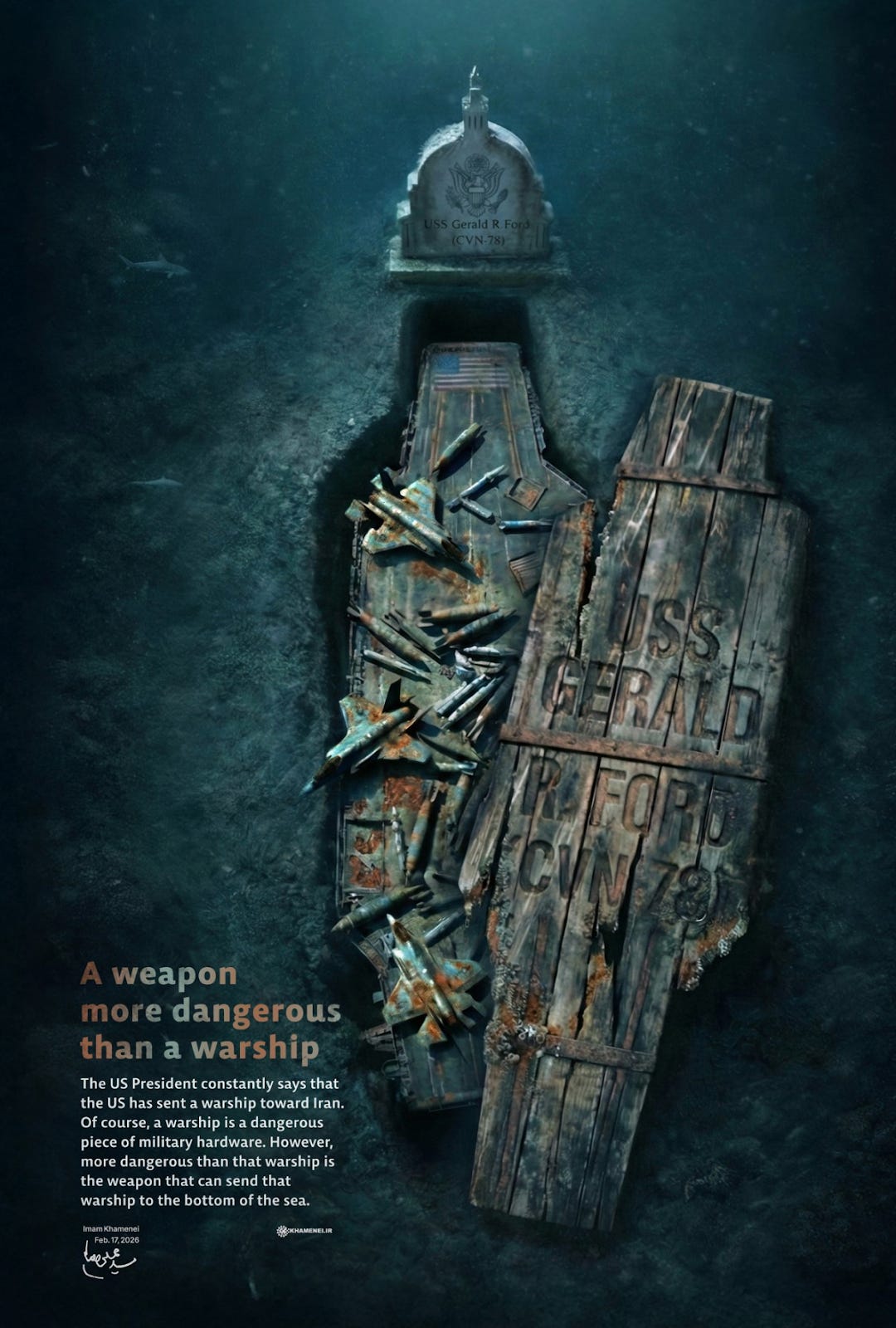
There is growing confidence among Iranian, Houthi, and Russian state media that a U.S. strike on Iran is not coming and that a deal is the more probable outcome. Hardline Iranian media repackaged a Trump envoy's media appearance as an "admission" that the U.S. psychological operation against Iran had failed. A military analyst on Houthi television assessed that Trump "doesn't want war with Iran and knows it's not Venezuela." Russian opinion columnists wrote that Washington lacks the will to follow through on its own threats. Geneva hosted two negotiation tracks simultaneously this week (Iran-U.S. nuclear talks and a Russia-Ukraine-U.S. trilateral), and state-aligned outlets treated them as a single story about a country stretched across too many fronts. Then on Friday, U.S. Ambassador to Israel Mike Huckabee told Tucker Carlson that "it would be fine if they took it all," referring to Israeli control of land from the Nile to the Euphrates, and within 48 hours, every media sphere tracked in this report had picked up the story and put it to work.
Week in Brief
The second round of indirect Iran-U.S. talks opened Monday in Geneva, mediated by Oman. Hardline Iranian media declared nuclear enrichment rights “non-negotiable,” while IRGC-linked outlets used Omani statements to claim “tangible progress” and argued Iran has leverage because Trump needs a deal more than Tehran does. By midweek, the frame inverted: Tehran sent a formal letter to the UN warning of a “decisive response” to any attack, the IRGC Navy commander issued a maximum-deterrence statement, and Russian state media amplified CBS sourcing that Washington was “ready to strike as early as Saturday.” A joint Iranian-Russian naval exercise near a U.S. carrier appeared on both Houthi and Iranian outlets simultaneously with identical framing.
The Russia-Ukraine Geneva trilateral was described as “difficult but businesslike” across Russian state media. Chinese state media mirrored the framing. Russian opinion columnists were blunter: one argued the talks create “space and time for Russian military action,” while another claimed they are splitting “Zelensky’s gang” into two camps.
Houthi outlets ran Ramadan mobilization all week. Houthi state media published rallying slogans (”In Ramadan our mobilization is stronger”), tribal formations in Dhamar declared combat readiness under the hashtag “Ready for the Next Round,” and Houthi outlets republished a Russian forecast of imminent U.S. strikes on Iran. Abdul-Malik al-Houthi, the movement’s leader, delivered daily Ramadan lectures, each published in full transcript by Houthi state newspapers, a pace that turned religious programming into sustained strategic communication. By Feb 22, the lectures had become reactive to breaking news: al-Houthi addressed the Huckabee interview directly from the pulpit (see Deep Dive 2 below).
Hezbollah-aligned media documented Israeli violations in south Lebanon (drone flights, explosive drops, eight fighters killed in a Bekaa strike) and ran Nasrallah commemorative coverage timed to Ramadan. One Hezbollah-linked outlet featured Sheikh Fayyad, a senior Hezbollah cleric, declaring “this generation grows up loving the Sayyed,” while remarks by Naim Qassem, Hezbollah’s secretary-general and Nasrallah’s successor, that “the resistance continues in leadership, fighters, and people” were carried by a Houthi outlet, extending the message across the axis. Hormuz energy chokepoint coverage ran alongside tariff-driven market turbulence, linking deterrence and economic disruption in the same editorial space.
Chinese state media covered both Geneva tracks, and one analysis examining what signal Iran sends by conducting military exercises while negotiating framed it as a rational dual-track strategy rather than provocation.
Deep Dive
1. Iran Escalation
On Monday (Feb 17), the Geneva talks opened with process-forward framing: IRGC-linked media claimed agreement on “general principles,” Oman’s positive messaging was relayed as external validation, and a detailed analysis argued Iran arrived with its full team (political, legal, economic, technical), that Foreign Minister Abbas Araghchi sees “the path as clearer than Round 1,” and that Trump needs a deal to avoid war and to sell to voters.