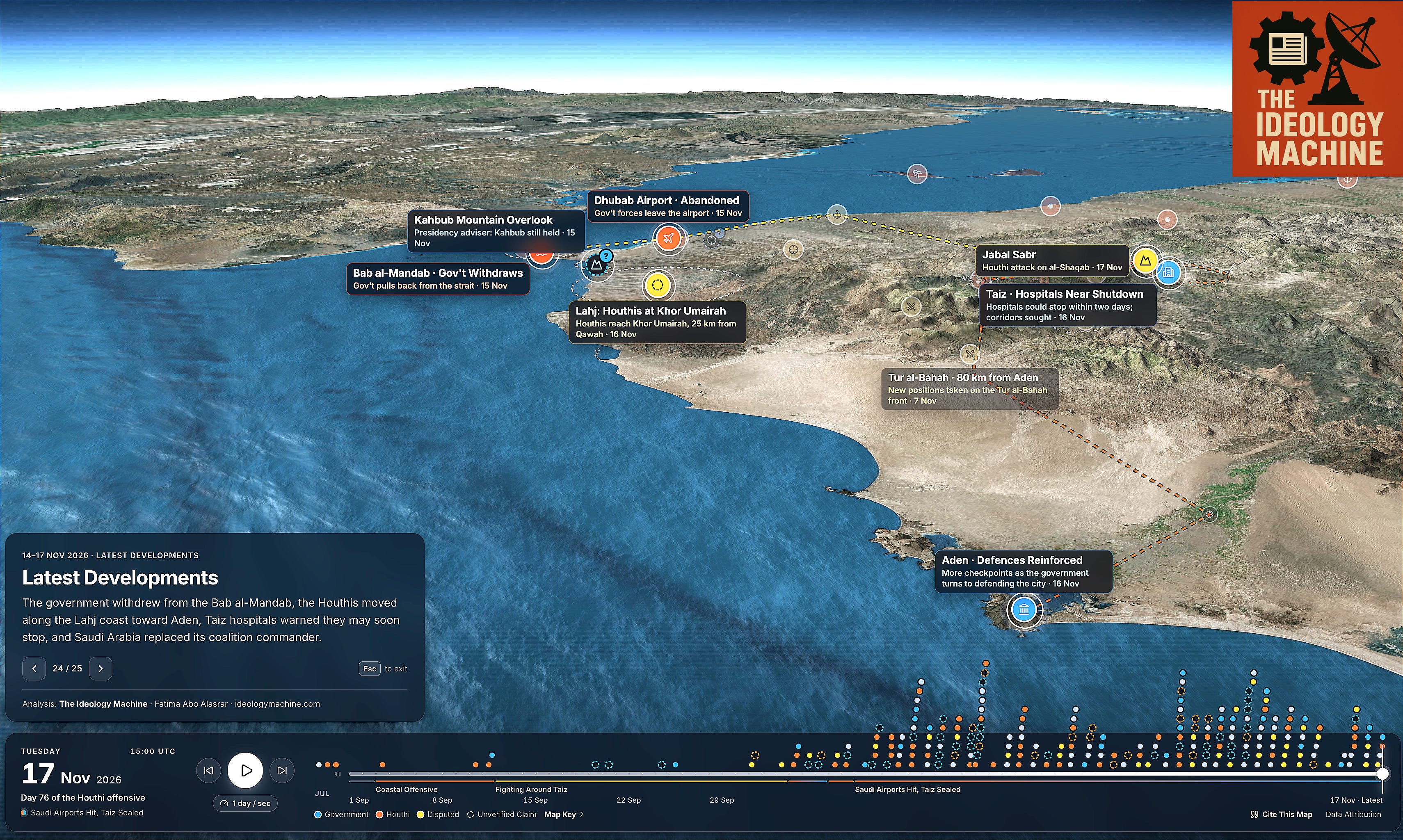
Fighting Washington to the Last Yemeni
How pressure on Taiz and Aden pulled government forces off the Bab al-Mandab coast, leaving Yemen to pay for the Washington–Iran war.

The Houthis’ recent penetration into southern Yemen, into Lahj and toward Aden, and the pressure they mounted in mid-November are an important new development, and it came as no surprise. Over the past several months, the Iran-backed Houthis have kept up the pressure on government-held territory, while government forces have struggled to contain their advances.
More than any other country in the Middle East, Yemen has become the shock absorber of Washington’s war with Iran. IRGC advisers helped the Houthis plan their offensive on the coast, and Tehran now has another chokepoint to use against the United States.
This operation revealed a profound asymmetry between the parties involved. The Iran-backed Houthis have moved to determine when and where to exert their military pressure, whereas Saudi Arabia and the Yemeni forces need to deploy their already thinning ranks everywhere in response to the Houthi escalation and expansion.
In Taiz City, a siege that has cut off humanitarian and military assistance and left 1.5 million civilians short of water and food is putting the forces defending the city under enormous strain. Aden, the interim capital of the internationally recognized Yemeni government, braces itself for a similar predicament as the Houthis advance through Lahj Province.