

A friend of mine once was able to summarize a Houthi cartoon I had shared with him in a way I have not been able to improve on: “Houthis, bad guys, good cartoons.” The line was funny, but the artist was no joke. He was a hostile member of the Iran-backed Houthi movement, deeply antisemitic, and overall, someone we would never agree with. But he is also someone who never missed the mark on global events, and his ability to influence went far beyond the Houthi movement.
It’s hard to imagine the average user taking this seriously, as most people would generally scroll past work like this without a second thought. That’s assuming they notice at all. The general assumption is that media produced by a militia is not worth serious attention. Analysts are not much different, as most Axis of Resistance analysis treats the movement’s authoritarian media as propaganda intended primarily for the militia’s own audiences.
But the question worth asking when watching these cartoons is what it means when the output is genuinely good, compositionally sharp, and the visual argument moves the audience. When art is used in a way that could make people relate to a cause, even when the basis of that cause is rooted in something fundamentally corrosive that we would not accept in our discourse. When the talent we see is not faked or coerced, or mediocre, and its message could stand on its own without context. Most importantly, what does that tell us about the system that produced it?
And so in Houthi-occupied Sanaa, there is a man who has likely never set foot in America and who chooses to portray Jeffrey Epstein with the same moral fixation reserved for victims’ advocates. And he paints Donald Trump with a venom most American cartoonists reserve for their own president. He feels strongly enough about ICE to criticize it, despite the aggressive stand his militia takes toward African immigrants. He also has strong opinions about the Nobel Peace Prize despite the violence that he himself preaches. His apparent moral conviction on these issues is so sharp that an American reader could mistake him for someone whose politics they share. And he has never, not once, turned that talent on the movement he serves.
For many years now, Kamal Sharaf has been practicing his craft in Iran-backed Houthi-controlled Sanaa, and while Sharaf undoubtedly possesses remarkable talent, what sets him apart is not simply the quality of his work, but what that work reveals about the system around him. Through his cartoons, we can glimpse beneath the surface of the proxy mechanism and examine how the system absorbs talent internally. Most importantly, Sharaf reveals an acute sense of the global political arena that few people associate with the Houthis, the “ragtag militia” that is continuously underestimated yet unmistakably sophisticated in its understanding of global politics.
But one of the things that makes Sharaf’s cartoons effective is that so many of them tap into grievances that his audience already holds. Sharaf understands the underlying anger that mobilizes his target audience in Yemen and beyond, and he plays on that like a musician plays his violin. He accentuates what he views as the hypocrisy of the Western world, while remaining selectively blind to his movement’s actions, which, at one point in his life, he opposed. He has plenty to say about Sudan, Palestine, Trump, and Epstein, but when it comes to Bucha, Houthi child soldiers, Iran’s killing of protesters, or the criminals within his own movement, there is nothing. And this is perhaps what makes his cartoons so revealing. For all the moral outrage that goes into them, it is an outrage that never seems to turn on the movement itself. What he chooses to criticize, and what he chooses to ignore, tells us a great deal about where the boundaries of that outrage lie.
While this essay is about one cartoonist, in reality, it is about something much larger. It is about the proxy model and how it works at the cultural level, and the conditions that produce the propaganda rather than just the propaganda itself. But perhaps more importantly, it is about what happens when the artist producing it genuinely believes he is free.
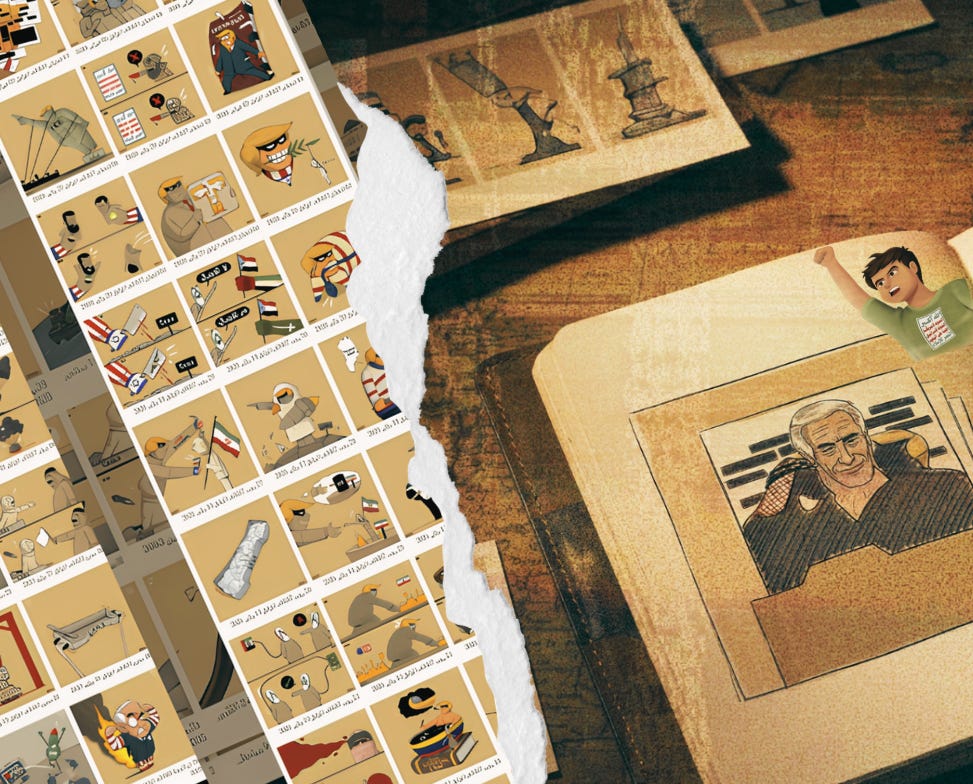
The Dissident Years of Kamal Sharaf
In 2010, four years before the Houthi takeover of Yemeni state institutions and well before the current conflict, the government of former president Ali Abdullah Saleh arrested Sharaf. At the time, he was a cartoonist at Al-Jumhuriya, the official state newspaper, and a government employee at the Ministry of Electricity, and he ran an anti-corruption campaign called Banbsrkum (we will observe you) on Facebook in his spare time. His brother Omar told NewsYemen that masked armed men in civilian and military clothing stormed their home during iftar, handcuffed Kamal, and took him to an unknown location. Reporters Without Borders and IFEX campaigned for his release.
After his release, Sharaf went back to drawing. And what he produced in the years before the war paints a picture of a cartoonist who was willing to criticize just about anyone, regardless of which political faction they belonged to.
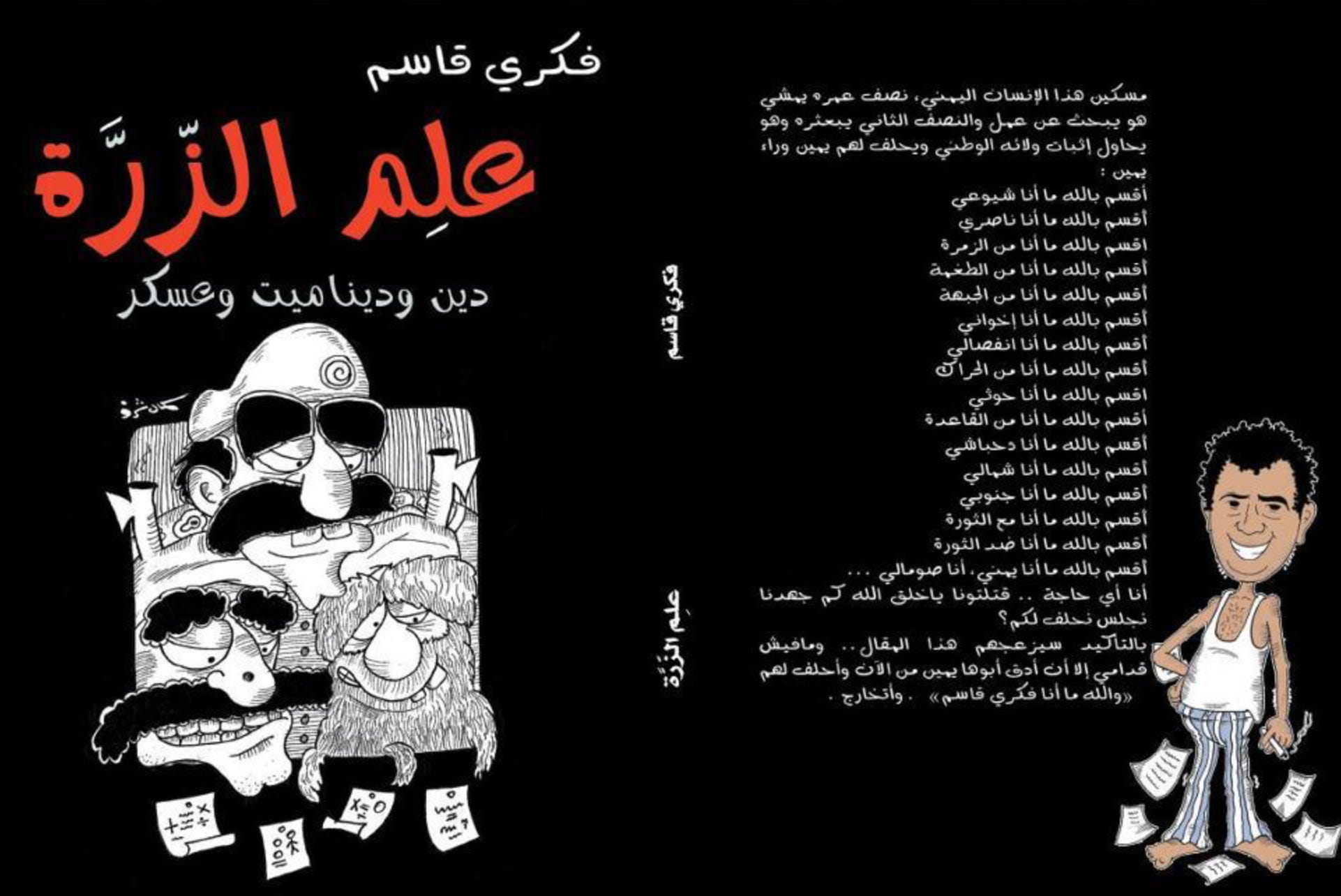
One of the covers he illustrated, for a Taiz satirical journalist’s book called Elm Al-Zarreh, a title that sounds like ‘nuclear science’ but is actually a pun on the Yemeni slang for being squeezed or ground down, caricatures the three pillars of the old regime under the subtitle ‘Religion, Dynamite, and Military.’ The back cover is a monologue in which a Yemeni man swears he is not a communist, not a Nasserist, not a Brotherhood member, not a separatist, not a Houthi, not al-Qaeda, not northern, not southern, not with the revolution, not against the revolution, until he gives up entirely and says he is Somali.
Sharaf also joined a civil society caricature project during the 2013 National Dialogue. He wrote an op-ed in Aden Al-Ghad arguing that real intellectuals try to understand people's problems in order to create change, and to open people's eyes to the truth, while the fake ones are afraid of people understanding, because they would be the first to be exposed.' And in early 2015, as the war was starting, he organized a caricature exhibition in Taiz called 'Our Wrong Paths,' which he said would critique 'the negatives of religious discourse that supports the spread of hatred,' and ran a children's cartooning workshop under the banner 'My Beloved Yemen' where kids drew the flag, the republican eagle, folk costumes, and Yemeni architecture, all in service of what he described as 'rooting the values of belonging, love, tolerance, and pride in this country.' That is the tradition Sharaf was working in before the war.