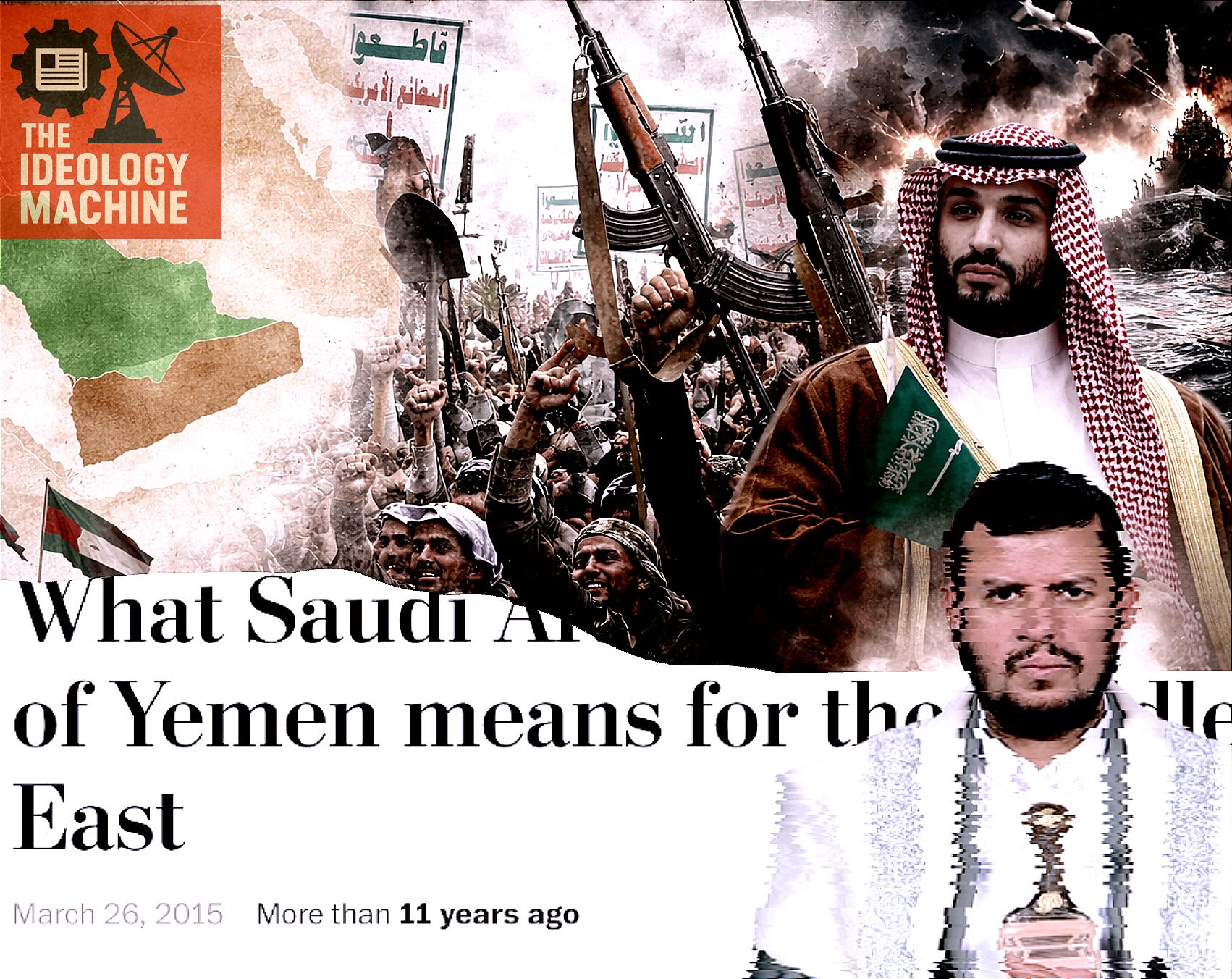
The Saudi-Led War at Eleven: How Iran's Houthis Survived the Storm
On March 26, 2015, Saudi Arabia launched Operation Decisive Storm to dislodge the Houthis from power in Yemen. Eleven years later, the movement is stronger, more connected to Iran, and more dangerous.
There are moments in life where some scenes stay with you as a whole, preserved in the exact light of the room where it found you. I remember when I was in Massachusetts, when a friend from the Kuwaiti embassy called to wish me well and to break the rather sudden news that Saudi Arabia had launched airstrikes on Yemen. Naturally, I slightly panicked, but he told me not to worry, that it would be over in about three months. He said that the coalition needed to teach the Houthis a lesson. I truly hoped he was right. Diplomats have their own way of making certainty feel contagious. But having covered the Houthis’ armed rise in Yemen for about a decade, I knew his math did not add up.
It is hard to imagine that eleven years have passed since the Saudi-led intervention, Operation Decisive Storm, and that the Houthis have not really been dislodged. It is even harder once you understand that the Houthis’ entrenchment is a product of accumulated mistakes and not their resilience. The coalition led by Saudi Arabia and the UAE certainly had the firepower, but they did not have a plan for the kind of mistakes and challenges of this conflict. They could not see anything besides military success, and when that was not achieved, they had no plan for what comes afterwards. And without a strategy that recalibrated, every military failure became a political gift to the Houthis. To their credit, the Houthis learned to circumvent the system, gain sympathy, and win the court of public opinion in the first years of the war, in the same way that a defendant keeps getting acquitted, not because of his innocence, but because the prosecution keeps mishandling the evidence and trying the wrong case in the wrong court.
The Threat Was Real
Most people who followed Yemen from the outside never really understood the calamity of what happened there, and many who were inside during the takeover decided to live with the cards that they were dealt. But what made the Houthis’ power grab so difficult to grasp, even for those living through it, was that it didn’t announce itself as a rupture. It didn’t arrive with tanks and bombs. It didn’t require a revolution per se. There was no single morning when Yemenis woke up and understood that the country they had known was effectively under Iran-backed occupation. Instead, it was a slow erosion of whatever predictability they were used to, a normalization of things that were never supposed to be normal. Political opponents were plucked one by one.
A quiet internal migration took place as senior members of the government and their families were placed under house arrest or harassed. A reverse migration from Sada to Sanaa brought people from the highlands into urban areas with tribal practices that the capital had left behind for decades. The city’s features changed, though the buildings remained the same. The abnormal became the texture of daily life, and the effort of noticing it felt like more than anyone could afford. A power grab like this would have met more resistance in a functioning system, but in Yemen, much of that capacity was already spent. After years of crisis, especially after the Arab Spring, many were politically exhausted. Moving on became the only viable option. Resistance itself no longer promised the rescue that people had sacrificed so much for.
The Houthi takeover of Sanaa in September 2014, followed by their consolidation of power into early 2015, was a real political crisis. The Houthis threatened their opponents, took over state institutions, used Yemen’s government weapons to block a fragile transition, and openly built ties with Tehran, even announcing direct flights between Sanaa and Tehran. They put President Hadi under house arrest and then forced him into exile. They broke every political agreement they had made, and when Ali Abdullah Saleh, the former president who helped them take Sanaa, became inconvenient, they killed him too.
From the outside, the conflict was flattened into a Sunni-Shia framing that was convenient for a Western audience and bore almost no relationship to what was actually happening on the ground. The Saudi-Iran rivalry became the only lens through which Yemen made sense to outsiders, when the more accurate framing was that an Iranian-backed movement had seized a country from the inside and a Saudi-led coalition was destroying it from the outside, and Yemenis were caught between the two. Yemenis, who had never been fanatical about religion, were suddenly asked to practice and perform a faith that bore little resemblance to their own Zaydi traditions and far more resemblance to Khomeinism. The framing made the conflict legible as great power competition, but it erased the Yemenis who were living inside it.

Not a Proxy, an Axis Member
It was genuinely frustrating to see a Sunni-Shia framing imposed on Yemen’s conflict because that was not the story inside Yemen. It is true that for roughly a millennium, northern Yemen was governed by an imamate system in which political authority belonged exclusively to people who claimed genealogical lineage with the Prophet Muhammad, ruling by a bloodline called sayyid, or Hashemite. The 1962 revolution overthrew that order and established a republic. But the Houthi movement resurrected the logic of the imamate and placed lineage above citizenship and enforced it through coercion, indoctrination, and institutional capture. For millions of Yemenis, this was a lived regression, the return of a supremacist order that their forefathers fought to dismantle. For a small minority who felt privileged, this was the way Yemen should have always been run. That some people were comfortable within the Houthi order wasn’t a surprise, but the bigger surprise was that they were able to capture the imagination of the West and convince it of their independence. Everyone else who did not exist in the Houthi system was a mercenary, a Saudi-UAE-Zionist-American agent.
The Houthi narrative about their own independence traveled at the speed of light. They convinced their domestic audience, international agencies, and media organizations that they were independent and homegrown, which was partly true, but not the whole truth. They were an armed dynasty that had learned to dress power in the language of God and to treat the state not as a public trust but as a protection racket, extracting wealth, loyalty, and silence from the population in exchange for the privilege of not being destroyed.
Houthis cultivated a clandestine relationship with a Shia transnational network that went completely undetected. Iran denied arming them, and the denial held weight because the evidence was always dismissed as scant rather than treated as cumulative. Every weapons interdiction was met with analysts arguing about whether the volume constituted a real pipeline, as though a movement manufacturing ballistic missiles in one of the poorest countries on earth was doing it with ingenuity. The whole discourse got lost in a debate about whether they qualified as a “proxy,” and that word became a trap, because the moment you argued about the label, you stopped looking at what was actually moving between Tehran and Sanaa.
Selective Blindness
There were patterns that, in retrospect, should have drawn more scrutiny. The UN envoy Martin Griffiths addressed Abd al-Malik al-Houthi as “Sayyid,” a genealogical honorific, as though the man leading an armed takeover of a republic deserved the diplomatic courtesy of his caste title. The Stockholm Agreement handed the Houthis control of the Red Sea coast at the precise moment when Yemeni government forces were positioned to dislodge them. And yes, it would have been a humanitarian catastrophe, but there was not even the illusion of pressure exerted on the Houthis. They used the threat of a humanitarian catastrophe to their advantage, a tactic that we understand so well given the multiple conflicts that have erupted in the world, but at that time it was something very difficult to see. Western media outlets, including the Washington Post, published op-eds from one of the most violent members of the movement, Mohammed al-Houthi, giving him a platform in which he talked about peace unchecked. None of this was coordinated in any deliberate sense, but the cumulative effect was the same. The Houthis were treated as a legitimate negotiating partner while the people opposing them were treated as obstacles to peace.
It is also important to understand that the humanitarian crisis was front and center in discussions about Yemen, as though the suffering itself were the entire story and not the product of a political and military architecture that no one wanted to examine. Images of malnourished children were consumed as moral indictments of the West that supported the coalition, but almost never with any scrutiny of who controlled access, or diverted aid, or who benefited from the guilt those images produced. Organizations raised money, governments pledged funds, but the crisis never stopped. It is worth noting that Yemen is arguably at its worst right now, and the same voices have gone quiet. Why? Because the money has dried up and the political utility of caring has expired.
Meanwhile, the Biden administration reversed the Houthis’ terrorist designation, and whatever the merits of that debate, it became a win for the Houthis on the ground because the pressure had eased. It was not a coincidence that the Houthis chose that moment to march on Marib, one of the most important cities in Yemen, and attempt to take it over. Understandably, the broader policy conversation focused exclusively on the American relationship with Saudi Arabia, on arms sales and humanitarian law, but it also took a much more flexible view of the Houthis and Iran. Taken together, this was not a series of isolated misjudgments but a pattern that recast the Houthis from an armed takeover into a legitimate negotiating partner. Fast forward to October 7th, and the Houthis started a war in the Red Sea and fired at Israel. In that moment, the skeptics’ warnings came to pass, and it sparked a new understanding of the Houthis that was no longer confined to policy circles in Washington. All of a sudden, the risks became high and visible, and for the first time, the general public started asking who the Houthis were.

The Mutation
The disaster is that when Saudi Arabia launched Operation Decisive Storm, the Iran-backed Houthis were a militia with a grievance, a government arsenal, and a political ideology that most people outside Yemen had never heard of. Eleven years later, they are a governing authority that administers territory, collects taxes, runs kangaroo courts, operates media and propaganda ecosystems, builds ballistic missiles, disrupts global shipping lanes, and maintains an ideological-political infrastructure that connects them to Iran’s revolutionary project. Is this entirely the fault of the intervention? Not necessarily, but it is not separate from it either. The coalition went in with conventional power and an assumption that force would be enough, and when it wasn’t, nobody recalibrated.
To be fair, the coalition did achieve real gains in the south, pushing the Houthis out of Aden and liberating southern territories, thereby stabilizing parts of the country and giving millions of Yemenis a measure of relief. But those victories were never matched by a political strategy capable of translating military progress into durable governance, and in the north, where the Houthis were entrenched, the war settled into a stalemate that favored the side with more patience.
Every airstrike handed the Houthis a narrative of self-defense and a reason to use weapons smuggled from Iran, China, and Russia. Yemen became a live testing ground for Iranian arms against regional adversaries. And when Iraqi militias hit Saudi Arabia, the Houthis claimed credit because they could afford to. The international community already saw them as victims, not instigators, and that perception gave them cover that no other member of Iran's axis enjoyed. And because the Houthis were seen as victims, the coalition couldn't recalibrate without looking like the aggressor.
The strategy didn’t adjust when military objectives stalled, or when Stockholm pulled government forces back from Hodeidah, or when the humanitarian narrative overtook the political one. What was clear is that throughout all of it, no one was prepared for how effectively the Houthis would run their information war. The Houthis controlled who was seen suffering and why, and that narrative shaped international policy in ways the coalition never anticipated and never figured out how to counter. The end result is what we are living with now. A movement that should have been dislodged was instead given the time and the political cover to entrench.
The final indignity was that the war’s authors ended up negotiating with the very movement they had set out to destroy, on terms that favored the Houthis. Saudi Arabia, battered by international criticism, arms sale suspensions, and a reputation crisis that turned it into a pariah over Yemen, was actively seeking an exit. The attack on its oil installations exposed the limits of its own defenses, and the antipathy from American audiences who saw the attack as Saudi Arabia’s problem, not theirs, made it clear that restoring Yemen’s government was more challenging than what was initially anticipated. What followed were backchannel dealings between Saudi Arabia and the Houthis in which the coalition’s original objectives quietly gave way to short-term security arrangements, and Yemenis, as always, bore the cost of arrangements made above their heads.
The Lesson Washington Could Learn
It is hard to compress a decade of what happened in Yemen into a few thousand words. It deserves a better examination, not out of vague academic interest, but because Yemen is strategic in ways that great power competition demands and that analysts haven’t considered until recently. I cannot count the number of times that serious people in Washington have told me that no one cares about Yemen or what happens there. We even heard it from the Vice President’s own planning chat, where Vance wrote that “nobody knows who the Houthis are” while his team planned strikes against them.
These phrases of carelessness are repeated so often that they start to sound like wisdom rather than what they actually are: an admission of complete negligence. The irony is that the people who do care about Yemen are precisely the people Washington claims to be competing with. Russia, China, and Iran all care enormously. They looked at a country that the world’s most powerful nation had decided was not worth its attention, and they saw exactly what any strategic competitor would see, which is an opening in one of the world’s most important straits. It should be obvious by now that the Houthis did not become a threat to global shipping because Washington was paying too much attention. It is exactly because no one was. Yemen is the glitch in the matrix of American foreign policy, the place where every comfortable assumption about force, strategy, and the nature of the enemy broke down, and no one noticed until the ships stopped moving.
As Iran chokes off the Strait of Hormuz, the unspoken fear in every planning room is that the Houthis will do the same to Bab al-Mandeb, creating a pincer across the two most important maritime corridors on earth. This scenario was studied, war-gamed, and predicted for years. The only response anyone ever prepared was force, and force, as Yemen has spent eleven years demonstrating, was never enough.
The United States is currently engaged in a military campaign against Iran under circumstances that carry an almost theatrical resemblance to the conditions that preceded Decisive Storm. There is a genuine threat. There is a coalition. There is an assumption of technological superiority so overwhelming that the duration of the conflict feels predetermined. Every one of these conditions was also present in March 2015, and every one of them proved irrelevant to the outcome.
Yemen showed that force, even when overwhelming, is not sufficient to defeat a movement that is being reshaped by the war itself. The Houthis of 2026 bear almost no resemblance to the Houthis of 2015, and the distance between those two versions of the movement is measured entirely in the consequences of a war that was supposed to last a few months.
After sustained Israeli strikes and American military pressure, the Houthis are arguably more degraded than at any point since 2015. But degraded is not defeated, and this is a movement that has always known how to survive with less. What dies in these systems are names, maybe titles, but not the machinery itself, and anyone who believes that killing Khamenei and Larijani and a generation of IRGC commanders means the system will follow them should look at what eleven years of strikes on Yemen actually produced. These systems are built for moments of crisis, Houthis and the IRGC in particular, because they built an ideological system and exercised absolute control over large numbers of people, are akin to a chess player down to a handful of pawns who only need one to reach the back rank and promote. The question is not whether they have the capacity to rebuild, because they have done it before under worse conditions, but whether anyone on the other side of the board is paying enough attention to stop them before they do.
Today, Abd al-Malik al-Houthi delivered an anniversary address demanding that Saudi Arabia cease its hostility, release Yemen's revenues, and leave the confrontation with Yemen to the Americans and Israelis directly. Eleven years in, degraded by sustained American and Israeli strikes, the Houthis are still making demands they may no longer have the capacity to enforce. It is the biggest game of poker anyone in the region is playing right now.

March 26, 2026 marks eleven years since Operation Decisive Storm, and it turned out that it was not the three-month affair that my friend had promised it would be. It was a generational tragedy whose consequences are still compounding. The thing that was supposed to be small did not stay small. It fed on the war that was meant to kill it. And now I am watching similar assumptions take hold with Iran. President Trump declared regime change because the leaders are dead, but a 40-year-old IRGC system is still standing in the ruins. Two days after that declaration, the IRGC was enforcing transit permits on the Strait of Hormuz and turning ships back while its proxy media network broadcast the enforcement in real time. The leaders changed. The machinery did not. Yemen should have taught us that. Yemen is a cautionary tale, proof that wars fought without recalibrating, without a strategy that could adapt, do not destroy ideology machines. They feed them.


