The Myth of Iran's Ideological Straightjacket
Javad Zarif published a concession list in Foreign Affairs and called it victory. The Islamic Republic has been doing this for forty years.
There is a particular art to declaring victory while handing your adversary a list of concessions, and Javad Zarif may be its most practiced living performer. His article in Foreign Affairs last week declared that Iran is "clearly winning" a war in which the Supreme Leader has been killed, the IRGC's senior command has been gutted, thousands of civilians are dead, and critical infrastructure lies in ruins. It is the kind of distortion that Iranian officials have perfected over decades, and it would be easy to stop there. But beneath the audacity, there is a shift worth paying attention to, because buried in his triumphalist framing is a detailed concession list, including nuclear limits, reopening Hormuz, and a nonaggression pact. An article like this does not appear in Foreign Affairs without some kind of blessing from inside the system, and Zarif's writing said more about where the regime's internal conversation is headed than anything its officials are willing to say publicly
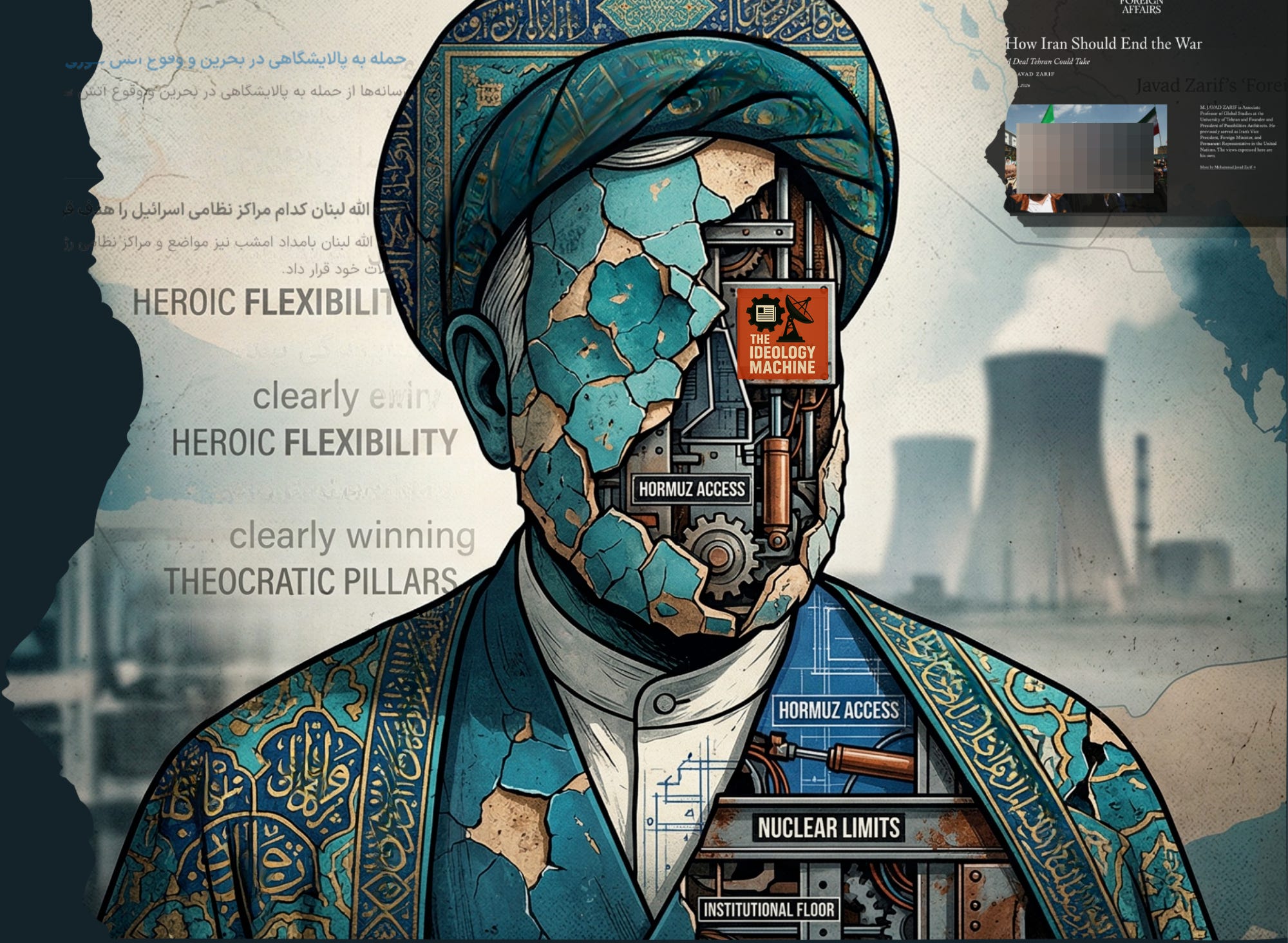
Iranian officials will never admit defeat, and some conversations have made it conventional wisdom, repeated with increasing confidence as the war intensifies, that the Islamic Republic will never capitulate. And it is clear why this is the case. Iran’s ideological architecture is too deep, its revolutionary identity too fused with the state apparatus, and its commitment to resisting the United States too structurally embedded to permit surrender under any conditions. So what follows is an understanding that pressure may degrade the regime’s capability but cannot alter its intent, and that the Islamic Republic can absorb punishment indefinitely because it understands itself to be engaged in a civilizational struggle in which compromise is indistinguishable from extinction.
I’ll admit there is something seductive about this line of thinking. But if we accept that no other outcome exists, we stop looking for one, and we start treating the regime’s own narrative about itself as an analytical conclusion rather than as a political performance, and in doing so, we foreclose the very possibilities that might otherwise be available to us. The word “ideological” does a lot of work in the current discourse, and it does so poorly. It functions less as a description of how the Islamic Republic operates and more as a shorthand for “irrational” or “impervious to incentives.” That conflation does not clarify the problem but rather obscures it.
The Theocratic Problem
To understand why this feels so intuitive, it may help to distinguish between political ideology and religious ideology, because they make fundamentally different kinds of claims.
Political ideologies, whether nationalist, Marxist, or liberal, tend to function differently. They ground their commitments in frameworks that can be revised through political argument. They are not set in a language that claims divinity, and although some of their rhetoric can sound extremist, the political goals they pursue can be accommodated through negotiation within their own frameworks. They can sell compromise to their audiences as something that made sense, as movement toward their own stated objectives rather than a betrayal of them.
Religious ideology, however, operates differently because it introduces a claim that sits above the negotiating table, turning every negotiation into a ticking time bomb, since the other party has not actually changed its convictions in a way that would instill confidence. So when the Islamic Republic claims divine right in pursuit of its nuclear program, or when the Houthis frame their resistance against Israel as a Quranic obligation, they are stating to their audience an authority that cannot be traded away. You cannot offer God a better deal, and you cannot bring God to the negotiating table. And this is what makes the idea that such a regime may never negotiate or fold feel intuitive, because the framework appears to seal itself off from the kind of cost-benefit reasoning that makes negotiation possible.
But the question of whether this holds in practice depends on what sits beneath the ideology, and this is where a crucial distinction emerges.
The contrast is sharpest in Syria. Ahmad al-Sharaa began his career within Al-Qaeda in Iraq, the very organization that became the Islamic State. He went on to lead Al-Qaeda’s Syrian franchise, Jabhat al-Nusra, then rebranded it as Hayat Tahrir al-Sham, cut ties with Al-Qaeda, put on a suit, met with Western diplomats, and is now running Syria. He manufactured a political floor beneath himself in real time, recognizing that ideology without institutional depth is a death sentence and acting accordingly. That trajectory, from Al-Qaeda operative to head of state in under a decade, is the most ruthless possible demonstration of what happens when ideology is treated as a deployable instrument rather than a fixed identity.
The Islamic Republic occupies a categorically different position because the Shia theocratic institutional ecosystem is based on a version of Khomeinism, which was nurtured in seminary networks, clerical hierarchies, juridical traditions, and structures of religious authority, all of which predate the 1979 revolution by centuries. The Houthis draw on a Zaydi imamate tradition with roots stretching back a millennium. The Taliban operate within Pashtun tribal governance structures that have outlasted every foreign intervention. So when the ideological posture becomes too costly to maintain in movements like these, there is something underneath to retreat to, whether institutional memory, political culture, or even survival instincts honed over generations. Movements that lack that depth, like ISIS, for example, have no roots to fall back on. Although I do not want to flatten the complexity or danger of these movements, which have been analyzed by many scholars, what is relevant to this discussion is that they are inventions born of their environment and the void that nurtured them. Violent movements like the Islamic State ride ideology into annihilation, while movements that possess it can absorb enormous contradictions without fracturing, because the ideology is just a layer, not the foundation.
What Theocratic Movements Actually Do
The Houthis allied with Ali Abdullah Saleh, the president who ordered the military campaigns that killed Hussein al-Houthi, the movement’s founder and spiritual figurehead. For the Houthis to enter into a formal alliance with the man responsible for their patriarch’s death required not a softening of ideology but its wholesale subordination to strategic calculation. They maintained the alliance for years and dissolved it only when the partnership ceased to serve their interests, and at no point did the movement’s ideological output, its slogans, its religious programming, its media apparatus, register this as a concession. The narrative adjusted after the fact.
The same mechanism played out more recently in the Red Sea, where one of the most persistent misreadings of the Houthi campaign is that the United States backed down and withdrew from the confrontation. The opposite is closer to the truth. It was the Houthis who sought the ceasefire, and the United States moved quickly to meet them there. But the narrative infrastructure did what it always does: Houthi media began describing the United States not as the Great Satan or the arrogant power but as a “pragmatic” country, preparing the movement’s base to accept a concession by reframing the adversary as rational rather than existential. And Abdelmalik Al-Houthi continued to maintain a stern public posture throughout the ceasefire, even as the language of his loyalists shifted underneath him.
It is worth remembering that with sanctions crushing the economy, former Supreme Leader Ali Khamenei gave the IRGC a speech in which he described diplomatic engagement as “heroic flexibility”, a formulation designed to give his base theological permission to accept what would have otherwise looked like capitulation. Two years later, Iran signed the JCPOA, sitting across from the “Great Satan” and agreeing to verifiable constraints on its nuclear program in exchange for sanctions relief. The deal ultimately collapsed, and as someone who was skeptical of the regime’s intentions throughout, I worried about both the proxies that the IRGC were supporting in the Arab world and the ballistic missile program that was never addressed by the JCPOA. But the point remains that Khamenei’s own language reveals exactly how theocratic movements package concessions: not as retreat, but as strategy. As Mehdi Khalaji, a Qom-trained theologian, has argued, Tehran's national security decisions are guided by interests rather than ideology.
The Mobilization Machine in Real Time
Today, as the U.S. and Israel continue striking Iran, state news media maintains its defiant messaging. Many articles misinform, such as the one claiming to have damaged the USS Abraham Lincoln, while others are transparent about their deterrence. One article in IRGC-affiliated Tasnim caught my attention, titled “The Region’s Final Cleansing from the Stain of Arrogance.” The language is apocalyptic: final cleansing, global arrogance, a cosmic struggle nearing its conclusion. But the actual argument underneath is about operational coordination, crisis management, and governance continuity, describing a leadership council structure designed to preserve institutional function under attack amid what it calls “multiplied crises.” Strip all of that away, and what you find is a theological framing over what is really a bureaucratic survival document dressed up in sacred language, produced for their own audience. Of course, they never introspect the way that we do. Our media is tearing our own administration apart over its conduct in the war, and that is not a conversation that authoritarian or theocratic regimes can afford to have, which is why their systems are more fickle than they appear. Democracies can withstand contradictions because we process them openly. For theocratic regimes, falling out of line deepens repression on top of existing repression, and it makes it easier for people to defect from the system entirely because there is no room to maneuver or even to breathe.
Predictably, the performance that followed Zarif’s article was just as revealing. Within days, hardline MP Hamid Rasaei called on the judiciary to arrest both Zarif and former president Rouhani for advocating an end to the war. A woman burned Zarif’s photo in the street, chanting “death to the compromiser.” But the Islamic Regime in Iran has never had difficulty silencing voices it genuinely wanted silenced. If the IRGC objected to Zarif’s article, the article would not exist. What the backlash tells you is not that Zarif went rogue, but that the IRGC and the clerical establishment are managing their own audience after sending a signal they needed sent. This is for domestic consumption in Tehran, meant to signal that the regime intends to endure, one way or another.

And it is not just Iranian media. Hezbollah-aligned outlets are doing the exact same war coverage that calculates the cost of American and Israeli losses without any focus on their own. Al-Akhbar ran pieces like “War Calculations and the Limits of Force” and “From Patience to Attrition,” which all sound like resistance slogans until you actually read them and realize the content is about missile cost ratios and how long U.S. coalition partners can hold together. One piece opens with Karbala framing, what they describe as the faithful few against the forces of evil, and by paragraph four, the author is calculating the cost of American aerial refueling operations. The headlines signal defiance toward content that is entirely about cost curves, attritional logic, and coalition cohesion, a far cry from their ideological resolve. And the mistake that Western skeptics of this war keep making is to take the defiance at face value while ignoring that these regimes are completely hiding their own costs, whether material or human.
What this looks like from the inside is apocalyptic language while calculation operates underneath it, sometimes in the same paragraph. The question is which track you are watching, because the conclusions you draw will differ entirely depending on whether you are reading the rhetoric or the reasoning beneath it.
The Sincerity Objection
Many who see democracies negotiate with ideological systems are skeptical of the endgame. If these compromises were tactical rather than sincere, do they count? If the Houthis allied with Saleh without genuinely abandoning their grievance, was that real negotiation? If Iran signed the JCPOA while preserving the aspiration to eventually resume enrichment, was that capitulation or performance?
The question is understandable, and in some ways we already have the answer. The Houthis themselves provided it when they killed Saleh the moment his utility expired. But it is also important to introspect, because these questions apply a standard that no party to any negotiation has ever met. The United States does not require sincerity of its own negotiating positions. Washington routinely enters agreements it has no intention of honoring on the timeline implied (even NATO is starting to look shaky), arms groups it will later designate as terrorists, and makes commitments that expire with each administration. The JCPOA itself was abandoned by the very government that negotiated it, and these movements have noticed. Iran watched the United States walk away. The Taliban watched Washington cycle through four different Afghanistan strategies across three administrations. Every group on this list has learned that deals with Washington have an expiration date, which paradoxically makes negotiation more likely rather than less, because the stakes of any single deal are lower. You are not signing away your identity. You are buying time, and every single one of these movements understands that perfectly well.
And this leads to a distinction that I think is critical. Negotiation with these regimes is not a path to transformation or liberation for the people on the ground. It is a management tool, and managing a problem is not the same as surrendering to it. The Houthis can be negotiated with, and doing so serves our interests, but it will not change what they are. They still hold guns to the heads of their own people, they pursue different agendas with different partners, and the minute they get a better deal from Russia or China, we know where their loyalty lies. And that is the part that should trouble us most, because even when these regimes negotiate, even when they bend, the people living under them remain trapped. The question of agency ultimately rests with those people, and their social contract with the regime determines whether real change is possible.
Ideology is not a set of instructions that movements follow but a mythology they use to maintain internal cohesion, project inflexibility, recruit, signal resolve, and justify the costs imposed on their own populations. In practice, it becomes a negotiating posture rather than a limit on what they can actually do. And none of this guarantees that Iran will capitulate. But the insistence that it never can, that the ideology makes it structurally impossible, is not accurate. What matters is understanding how ideological systems work and learning how to circumvent their bravado rather than simply meeting it with more of our own. When the president threatens to bring Iran "back to the Stone Ages," he is doing exactly the opposite, and as my friend Kian Tajbakhsh, a former political prisoner in Iran who was himself freed as part of the JCPOA wrote recently, the language sounds less like serious statecraft than punitive rage, and it only reinforces the anti-American narrative on which the regime thrives.
The danger is not that the regime will never negotiate. The danger is that it will, and that Washington will call it peace while the people who marched under “Woman, Life, Freedom” discover that the grand bargain was never about them. The Islamic Republic has survived for over four decades not because it refuses to bend, but because it bends toward whoever holds the leverage and away from whoever doesn’t. The leverage has never been held by Iranians.


