

This month, the U.S.-Iran war spilled into a new arena, and Yemen, along with Saudi Arabia, will carry the scars for years. The Iran-backed Houthis now hold most of the Yemeni coast along the Bab al-Mandab, a strait they had only been able to harass before. At the same time, Houthi ballistic and cruise missiles have hammered Saudi Arabia—some striking near Riyadh. Images of smoke rising near King Khalid airport did real psychological damage as Riyadh scrambled to organize a political response.
Two crucial developments capture the strategic constraints that are now confronting the Saudi Kingdom. First, Riyadh has been denied U.S. assistance in targeting the Houthis, repeatedly. Second, Saudi Arabia is running low on interceptors due to the Iran-backed Houthi missile and drone barrage that has allegedly depleted its resources.
But beyond Saudi’s immediate dilemmas, the American hesitation is the story worth paying attention to. A flimsy ceasefire between the United States and the Houthis is holding in the Red Sea that involves both parties agreeing not to target each other following two months of U.S. engagement in Operation Rough Rider. During ongoing discussions with the Houthis, President Trump allegedly stated: “The Houthis called us, and they don’t want to fight with us. They let us know they don’t want to fight with us.” What is striking here is that the U.S. seems more comfortable respecting a ceasefire with a Tehran proxy that has seized a critical chokepoint on Tehran’s behest than upholding eight decades of Gulf security architecture.
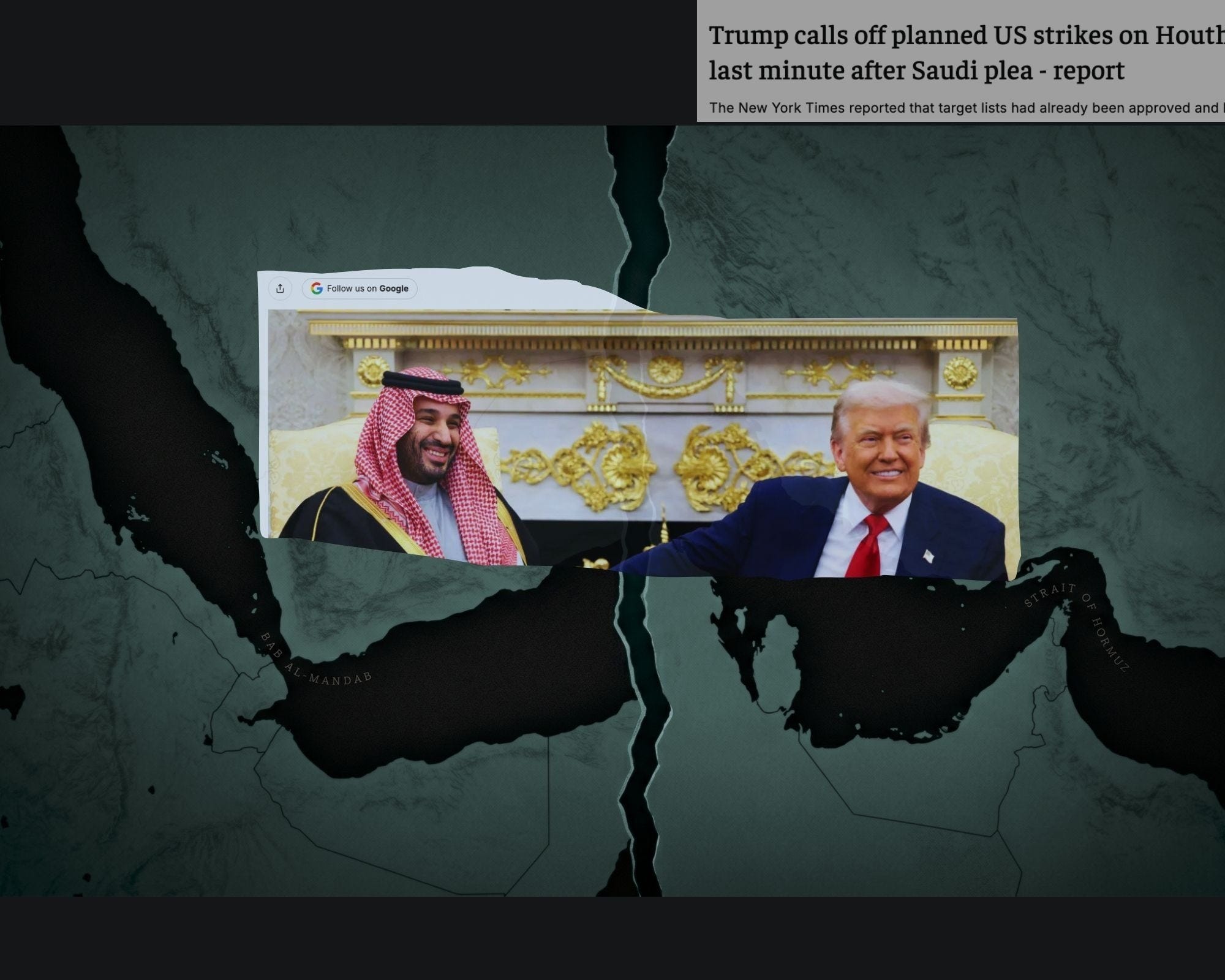
Pushing Washington to abandon its Saudi partner that hosts U.S. bases and stabilizes oil prices has been a core Iranian strategy throughout the Yemen war. Removing the U.S. from the equation gives Tehran and its proxies greater latitude to expand their reach and power. Tehran knows precisely which moves will keep Washington paralyzed, and the Houthis’ conduct over the past three weeks reveals the architecture of that strategy across three coordinated moves
The first move is to ensure there is no retaliation from Washington on the Houthis.
Both the Houthis and Tehran are working hard to shield the Houthis from American military retaliation for the costs they are imposing on global shipping. The tool they are using to keep Washington out is a ceasefire they have never treated as binding, as they have threatened to break it multiple times this year, including claiming a joint Iranian-Houthi attack on the USS Abraham Lincoln, carried out in what the IRGC called full coordination with the Houthi forces in May.
Although the attack never happened, Houthi media advertised this participation in a strike on an American carrier willingly, while their ceasefire with Washington was supposedly in force. But invoking the ceasefire is now politically useful and is being held up as proof of their good faith, without being challenged. On September 20, a member of their political bureau told the Associated Press that the group is “not targeting the United States or any other nation in the strait, with the sole exception of the Saudi enemy.”
Naturally, this statement spread like wildfire and was held up as proof of Houthi restraint. One can see why this would be naturally appealing at a time when the U.S. is spread too thin to open up another front. And perhaps one of the most catastrophic realizations for U.S. security is that this hesitation has made clear that the superpower Gulf countries relied on is too weak, too ill-calculated, and unwilling to confront a proxy emboldened by the U.S.’s weakened posture vis-à-vis Tehran.
The second move is to isolate Riyadh.
Saudi Arabia has been absorbing the fallout of the U.S.-Iran war since August despite not being a party to the conflict and urging for de-escalation with Tehran, even as Tehran attacked Saudi Arabia unprovoked under the pretext of it hosting American bases.
Riyadh has its own experience fighting with the Houthis, who have become Tehran’s strongest proxy not only due to their operational strength, but also their extensive diplomatic ties spanning from EU diplomats to Washington think tanks. Entangled with the Houthis in a war of attrition for five years, Riyadh realized that military and political asymmetry had been extremely consequential and damaging for the Kingdom.
This year, Saudi Arabia is being fundamentally attacked for its relationship with the U.S., however. Tehran has made it clear that all countries hosting U.S. bases from Qatar to Turkey are within its reach, and it will not hesitate to use force to impose costs on them. Saudi has become Tehran’s favorite collateral because the Houthis, with backing from the IRGC, can strike deep into critical Saudi oil infrastructure without triggering direct American retaliation.
This is the context for the Houthi statement naming Saudi Arabia as the sole enemy in the strait. Abdulmalik al-Houthi, the leader of the militia, has consistently and publicly attacked Saudi Arabia for its historic relationship with the U.S., and often refers to Saudi Arabia as an “American Zionist” project. Not as a trope, but as a way to delegitimize the Saudi Kingdom and custodianship of holy mosques due to their relationship with Americans and “Jews” and for hosting American bases and advisers and opening its airspace to Israel. Much of al-Houthi messaging is aimed at undermining Saudi Arabia’s standing as a Muslim state on precisely those grounds. The Houthis require an enemy whose destruction feels like piety, and their labels provide the condition that makes it possible.
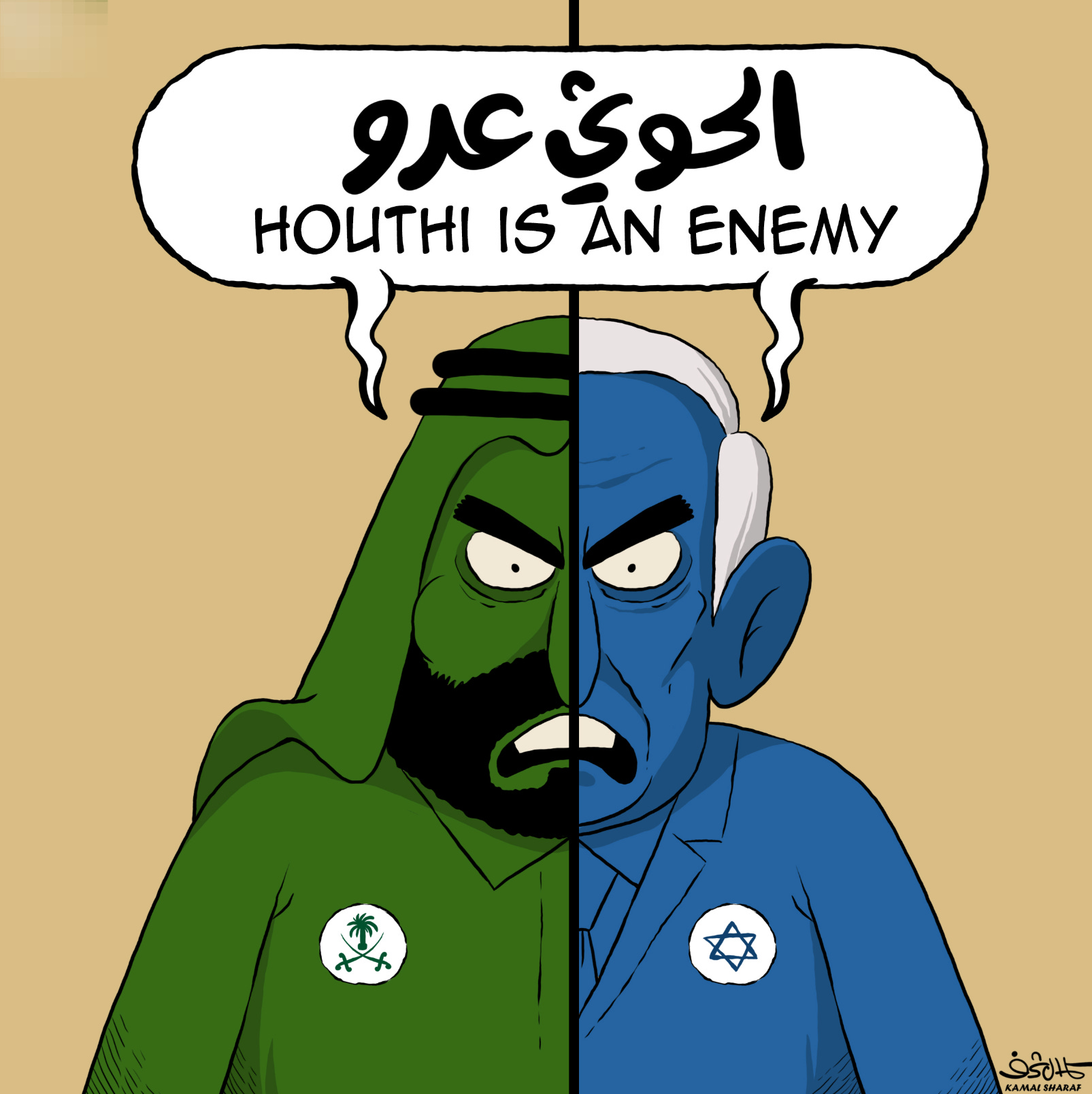
When Riyadh accused the Houthis of targeting Mecca, the Houthi militia’s military spokesman answered not with a denial but with anti-Semitic invective, attacking the Kingdom for bringing “prostitutes” into the country—a reference to concerts by Cardi B, Jennifer Lopez, and other female performers.
The seeming contradiction of punishing Saudi Arabia for its alliance with the U.S. while assuring the U.S. of compliance with the ceasefire is clearly a wedge strategy that rewards the U.S. for standing aside while its partner is punished. This is the quickest way for Tehran to break the alliance between the U.S. and the entire Gulf without it ever formally breaking it. And Washington is isolating itself in the process. Riyadh has asked other countries for air defense because its main partner hesitated. Ultimately, Tehran’s argument that America cannot be relied on starts to sound reasonable in Gulf capitals.
The third move is to consolidate the Houthi advance while Washington stays out and Riyadh remains under pressure.
This is the most devastating move, because foreign capitals remain focused on what chokepoints are under Tehran’s control without paying attention to the devastating civilian cost.
I wrote at length about the fall of Mokha, about the failure to stop the Houthis, and the hesitation of all partners to strike. But Houthi units entered Mokha by September 11 and within ten days, their entire media establishment was focused on administrative normalization and governance of the city. Houthi judges reopened courts across Mokha, Khokha, and Hays, alongside health delegations and fisheries officials, who rushed in to establish a bureaucratic presence. The speed of this takeover has been astronomical, involving the displacement of hundreds of thousands of Yemenis who left the comfort of their homes and fled to camps in the middle of the hot summer and the migration of around three thousand Yemenis who took a treacherous route to Djibouti.
Toward the south of Yemen, Houthis were warning that they would strike Saudi-aligned units (meaning Yemeni locals who oppose them, whether they are funded or not funded by Saudi), wherever they assemble. Their media outlets ran typical propaganda about Houthis’ military invincibility alongside continuous coverage of fuel inflation and power disruptions in Aden and Mukalla. This coercive pressure was matched by calculated political reassurance. In a September 17 address, Abdulmalik al-Houthi told populations across the southern and eastern governorates: “We are not targeting you.” Analyzing his speech for Houthi state media, a commentator candidly stated that al-Houthi’s reassuring tone masked a deliberate “political separation of adversaries.” By narrowing the declared enemy to Saudi-funded units and labeling them “takfiris,” the militia “seeks to lower local southern resistance, dissuade non-aligned factions from mobilizing, and prevent a unified domestic front from contesting their advance to the Bab al-Mandab.”
That consolidation gives the Houthis access to ports, revenues, coastal infrastructure, and the population itself, while making their presence progressively more difficult to dislodge. The human cost is enormous. Rapid totalitarian indoctrination and conscription has begun. Those who could not escape were ordered to become loyal to the Houthis’ cause, despite their ideological and political differences with the group.
Taken together, these three moves form an integrated strategy: neutralize the superpower with a carve-out, isolate the regional partner under fire, and swallow Yemen whole while the world looks away.
The Houthis could already threaten shipping without holding the strait. What territorial control adds is leverage over Yemenis and their domestic opponents, and a stronger position from which to pressure Riyadh. The longer they hold the strait, the harder they are to dislodge.
White House advisors who see that the U.S. needs to focus only on the crisis at Hormuz are somewhat correct on a narrow operational point: that airpower alone against the Houthis cannot exactly defeat them, as we have seen in the last decade of Saudi attrition and the two-month operational failure of Rough Rider. But that reality does not justify the current strategic paralysis amid active Houthi bombardment of partners and pipelines, nor does it mean that military force cannot decisively alter the battlefield.
Despite an extremely weak and undersourced government that is working with only one ally and no coalition, the Houthis are taking heavy losses on the ground. Their rapid coastal gains along the Red Sea are neither costless nor permanent. But the longer they maintain a grip on these resources, the greater their ability to expand into new territory. This not only places oil fields in Marib and Shabwa under threat, but also threatens millions in the opposition in these cities, and millions more in Aden and Hadramout who benefited from Saudi security guarantees that would not have existed without U.S. assurances.
This nightmare is not going to end for Washington anytime soon, especially if the administration thinks it can cut checks to circumvent it. Floating a five-billion-dollar fund to rebuild battered Gulf energy installations and bypass the Strait of Hormuz just gives the Houthis and Iraqi militias the opportunity to bombard the new installation. Laying pipelines around an active war zone—all while refusing to take action against the launchpads that are blowing them up—is sheer fantasy. Saudi’s East-West pipeline that was bombed at Yanbu, which was designed to bypass the strait of Hormuz, is proof.
Nor will rerouting barrels toward the Red Sea achieve anything when the Bab al-Mandab sits under the control of an Iranian proxy. As the U.S. scrambles to achieve some wins before the midterm elections, it will likely cut a short-term deal with Iran and the Houthis to gain immediate results, allowing Tehran to further strengthen the Houthis’ grip and cement their control until they are ready for the next round.
American policy right now is confused. It sits between an all-or-nothing choice—total intervention and absolute withdrawal—and it continues to overlook how leverage could shift the balance of power on the ground. Washington completely failed to apply targeted pressure on Tehran’s weak points and seems to be worried enough in its attempt to contain its proxy in Yemen. Ultimately, it might choose the path of least resistance, allowing the Houthis and Tehran to impose their own rules.
Yemenis have a warning for the world. The Iran-backed Houthis gained strength during pauses in conflict because those pauses allowed them to arm while their opponents relaxed. Judging by history, this lesson remains difficult to grasp.
Thanks to Pamela Kilpadi for editing the article.