


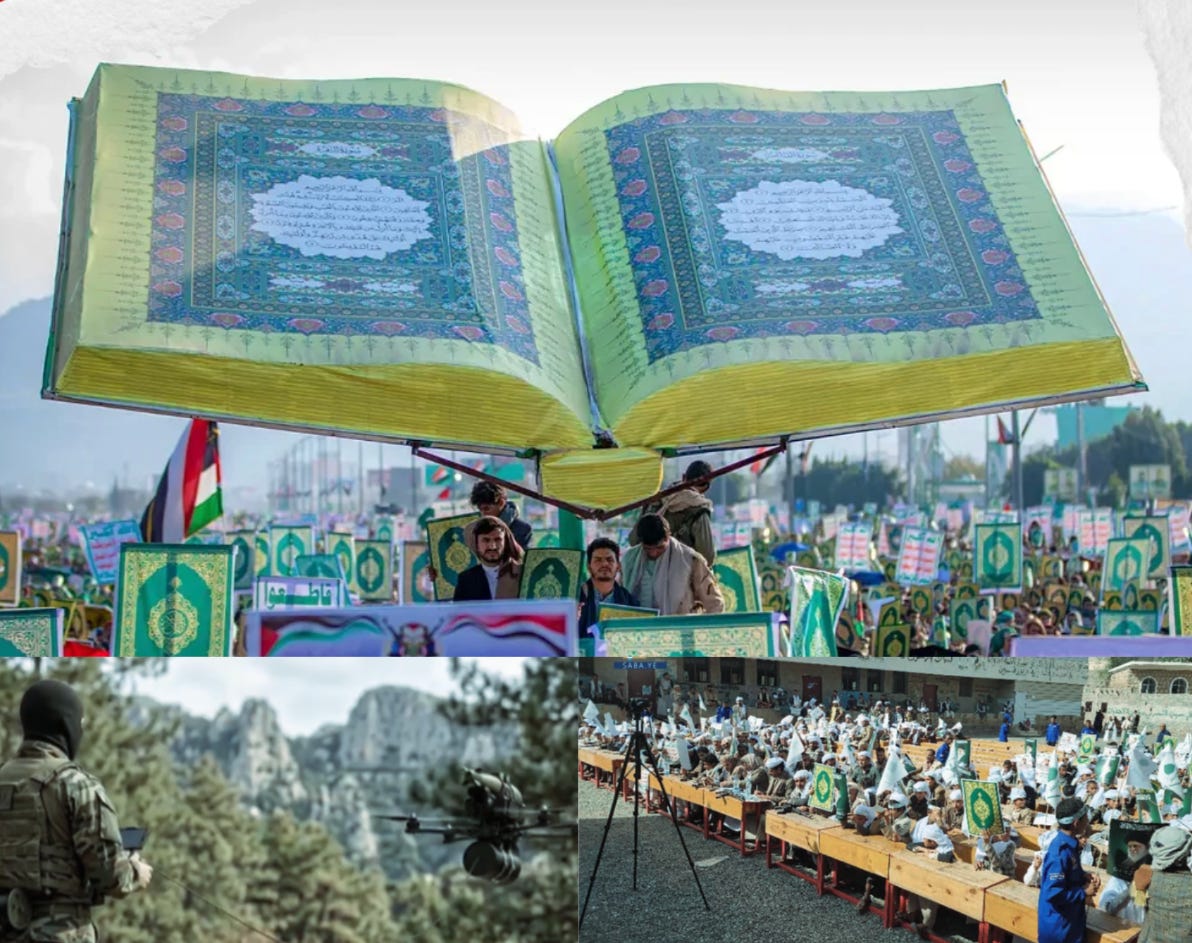
The Houthi leadership this week sought to mobilize Yemenis under their control to protest a Quran burning in Michigan, treating a minor incident by a far-right provocateur as proof of a civilizational Western campaign against Islam. Abdul-Malik al-Houthi issued a written statement on the burning, called for mass protests timed to the Friday prayer cycle, and then inaugurated a daily religious lecture series that was incendiary in content, naming Jews as the primary enemy of the ummah, among other usual hardline language. We shed some light on the drivers behind this mobilization. Moreover, the public performance that accompanied it required mass mobilization and the use of coercive measures to incentivize the Yemeni population under their control to attend. The Ministry of Civil Service released government employees early to attend the protests. Government ministries staged their own standalone events under the same slogan. The Iran-U.S. confrontation aftermath dominated the rest of the week, with the Strait of Hormuz and U.S.-sourced cost data presenting American military power as overextended and losing leverage.
Houthi media also published extensively what amounts to an open inventory of Hezbollah drone tactics this week, emphasizing that $400 drones are disabling Israeli tanks to show that non-state groups can impose this level of cost on Israel at this price point. The same week, a Yemeni fighter captured in Ukraine told an interviewer he was promised civilian work, deceived, and pushed to the front by Russian handlers. Although the story was extensively reported across international and Yemeni opposition media, Houthi outlets remained silent on it, choosing instead to dedicate editorial energy to the dispute about a woman who calls herself Mira Saddam Hussein.
Week in Brief
The Iran-U.S. confrontation aftermath set the international agenda before Houthi domestic coverage took over. Iran was presented simultaneously as diplomatically aggrieved (a Hague filing seeking condemnation and compensation), militarily intact (NYT-sourced assessments that Iran recovered most of its missile facilities), and anchoring a post-American order (Qalibaf describing a “new global order” and being appointed Iran’s special representative for Chinese affairs). At the BRICS summit, Araghchi said delegations acknowledged the failure of the war’s goals against Iran and publicly named the UAE as having been targeted for hosting U.S. positions. General Jafari listed preconditions for negotiation that amounted to full-capitulation terms: an end to the war on all fronts, sanctions relief, compensation, and recognition of Iranian sovereignty over the Strait of Hormuz.
The Quran-burning mobilization then absorbed the domestic coverage for the rest of the week. What made it analytically distinct from routine Houthi protest cycles was the institutional depth. The Shura Council, the Ministry of Endowments, the Scholars Association, and the Houthi Political Bureau all published separate condemnations on the same day as al-Houthi’s statement. Governorate rallies spread across the north under a shared slogan linking the Quran, Al-Aqsa, Lebanon, and readiness. A Monday march at Al-Sabeen Square, called a “million-person march” for expected high attendance, was announced in al-Houthi’s name. And then the civil-service circular, the ministry-level protests, and the police-graduation framing layered institutional alignment onto the street mobilization.
Abdul-Malik al-Houthi has not appeared on video since his April 21 Sarkha anniversary speech, a 28-day gap, and has recently been substituting written statements for video appearances, which is unusual for him. The Mufti received increased coverage. Deputy foreign minister Hussein Abu-Ras met the Russian ambassador, met the acting UN Resident Coordinator, and told Hezbollah’s international relations official that Hezbollah’s weapons are “an element of strength that should be preserved.” Abu-Ras worked the diplomatic-operational side while al-Houthi worked the theological one.