Beyond Hormuz: The Sanaa Airport Strike and the Architecture of Iranian Proxy Power
By resisting international inspections, the Houthis and Iran are trying to secure the same type of unmonitored gateway that anchored Hezbollah’s power in Beirut
This is an excerpt from my latest article published earlier today by the Stimson Center. Link to the full post below.
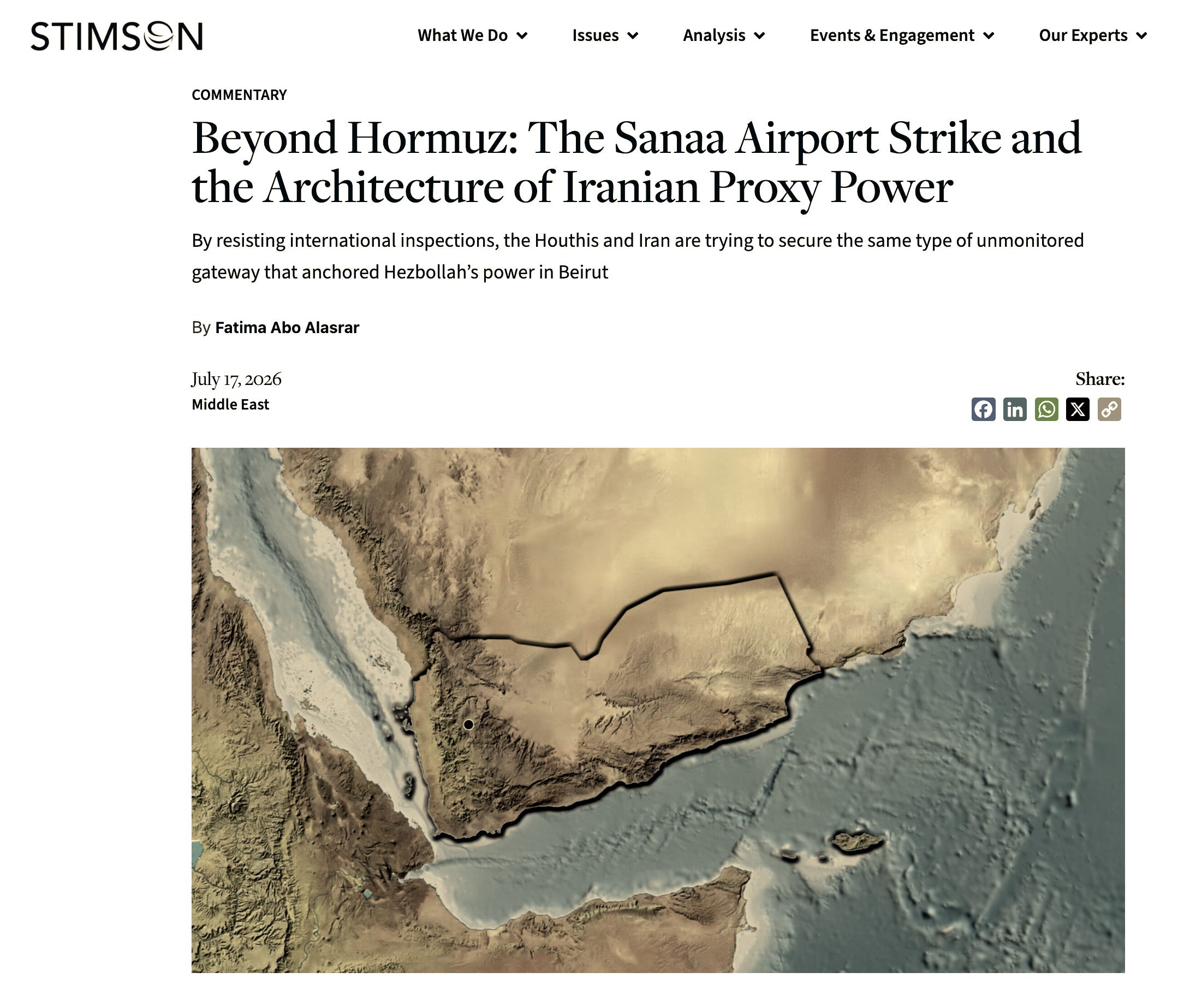
An Iranian airliner circling above a cratered runway at Sanaa is the clearest picture of what Iran is trying to establish on the southern part of the Arabian Peninsula.
The Saudi-led coalition strike on July 13 did more than turn back a sanctioned Mahan Air flight carrying a Houthi delegation home from the funeral of Iran’s supreme leader, Ayatollah Ali Khamenei. It was an attempt to interrupt Iran’s effort to establish a permanent air link into Houthi-controlled territory that no one outside Sanaa could inspect. Land and maritime routes have come under increasing pressure from interdiction since 2024, and Iran is running its pipeline through a civilian airport because covert routes are gone.
The strike on Sanaa airport was a fight over inspection, access, and recognition as Iran tries to build in Yemen a proxy similar to Hezbollah in Lebanon.
The dispute was never about whether a plane could land. Rashad al-Alimi, head of the Presidential Leadership Council, said the government offered to bring the Houthi delegation home aboard a Yemenia charter, but the Houthis insisted on Mahan Air, an airline under U.S. sanctions for moving weapons and personnel for the Quds Force, the external branch of Iran’s Islamic Revolutionary Guards Corps (IRGC). Flights into Sanaa can land under existing arrangements if they route through a Jordanian airport for inspection. The Houthis allegedly refused this option, making it clear that the objection was never to the route, but to the inspection mechanism. In the end, the plane landed at the Red Sea port of Hodeidah.
The Houthis retaliated within hours, striking Abha airport in Saudi Arabia with missiles and drones and warning airlines away from Saudi airspace until what they call the blockade on Sanaa is lifted.
The crisis has been building for the past two months as the Houthis have escalated their rhetoric against Saudi Arabia, accusing the Kingdom of imposing a humanitarian blockade. But at the core, both the Houthis and Iran have set their sights higher. They want to displace Yemen’s internationally recognized government and install the Houthis as a de facto governing authority.
The operation suggests that both Tehran and the Houthis calculated that Riyadh would target the runway rather than the aircraft because the risks of downing a funeral delegation on a civilian carrier was not an acceptable political cost, which left the Kingdom to crater the runway and force a diversion.
The incident highlights a critical aspect of Tehran’s regional strategy. Iran does not build proxy power exclusively with missiles, but by capturing the physical infrastructure through which state sovereignty is exercised. International gateways are among the clearest expressions of that sovereignty, because they determine how a state meets the outside world, who enters and on whose terms. Iran is exploiting a moment of regional instability, lashing out across the Persian Gulf through asymmetric pressure over the Strait of Hormuz and through proxies, in an effort to exhaust Washington’s appetite for holding the line.
What looks like a sudden escalation is the resumption of a project that began over a decade ago. In February 2015, just weeks after the Houthis seized Sanaa, their leadership signed an aviation agreement with Tehran authorizing fourteen weekly flights, with the first Mahan Air service landing on March 1 under humanitarian cover. That flight carried IRGC and Hezbollah advisers alongside arms and logistical supplies, and later that month, a shipment of roughly 180 tons of weapons was intercepted at Saleef Port in Hodeidah. Back then, the Saudi-led Operation Decisive Storm closed the corridor after the coalition took control of Yemeni airspace, and the runway at Sanaa was struck that year to stop Iranian aircraft from landing. Eleven years later, the same airport is being struck for the same reason, this time to keep the IRGC from restoring the corridor.
Iran ran the same play in Beirut long before applying it to Sanaa. Rafic Hariri International Airport, positioned next to Hezbollah’s stronghold in the southern suburbs, became the critical asset. Controlling the airport and the roads allowed Iran to move cash and materiel through uninspected diplomatic bags.
When the Lebanese government in June reopened René Moawad Airport at Qlayaat, in a northern region outside Hezbollah’s reach, the response was immediate. For Hezbollah, a second airport meant a route into the country that did not pass through Dahieh, that it could not watch or tax or close, and that the state could use to bypass the movement entirely. The party’s own channel ran Prime Minister Nawaf Salam insisting that Qlayaat was not a replacement for Beirut’s airport, a reassurance no one would give unless the replacement were exactly the point. For Hezbollah, the value of controlling Beirut’s airport depends on there being no alternative to it.
A link to the full article can be found here on the Stimson Center website.


