


The Houthi political project this week converged on Saudi Arabia. Three campaigns converged in parallel: a Tanuma-1923 grievance that saturated Houthi media, a celebration of Iranian strikes on the UAE, and a spy-network operation that converted announced confessions into a domestic state-building campaign. Hormuz dominated international headlines.
The Mufti Shamsaddin Sharafaddin is increasingly stepping into the political-spokesman role, and the movement is building a clerical authority structure to carry it.
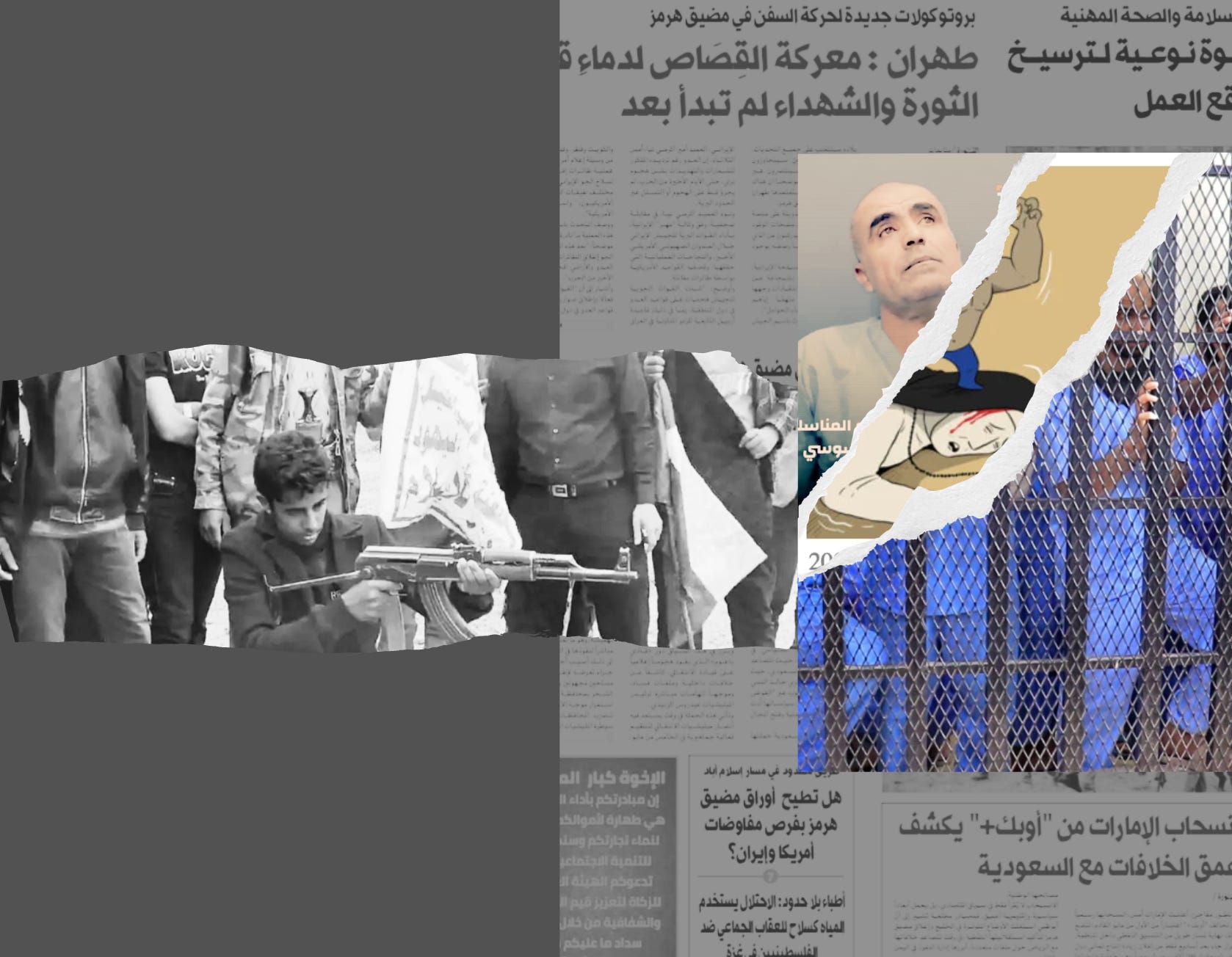
Week in Brief
The Mufti Shamsaddin Sharafaddin’s Friday May 1 sermon framed the United States as at its weakest point and named “sharp disagreements among its officials” as evidence of the “end and fall of the American tyrant.” The Mufti is increasingly stepping into the political-spokesman role from the Friday minbar, and the movement is building a clerical authority structure to support it. Acting Prime Minister Mohammed Muftah was visible only inside governance items on Information Ministry coordination and Civil Service merger procedures on May 3, both of which could be viewed as routine.
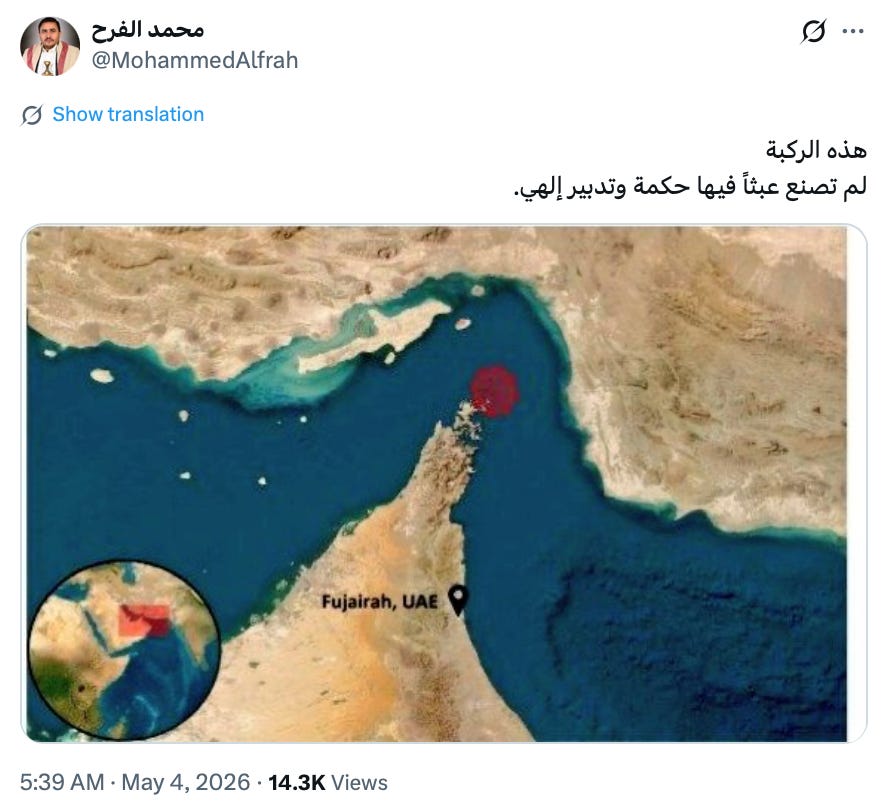
Mohammed Al-Fareh, member of the Houthi Political Bureau was posting prolifically on X this week. His May 3 post on Saudi intelligence “continuing to recruit cells” reframed the alleged ongoing Saudi-Houthi de-escalation as cover for war by other means, which signals a coordinated campaign in Houthi media to pressure Saudi Arabia. Hasan Sharafaddin, former Minister of State during the National Dialogue phase, amplified Hezbollah and circulated archival material from Mohammed Ali al-Houthi to perform institutional continuity without requiring any new senior statement. Deputy Foreign Minister Ali Abu-Ras issued a statement attacking the Saudi government for receiving “Zionist teams” while Gaza burned.
Hormuz set the agenda. The Houthi Foreign Ministry issued an April 28-29 statement backing Iranian measures in the Strait, calling U.S. action “piracy,” and stating explicitly that Yemen “is not neutral regarding attacks on Iran, Lebanon, and Palestine.” That single line is the doctrinal anchor for everything that followed. Iranian President Masoud Pezeshkian called the U.S. blockade an “extension of military operations against Iran.” Parliament Speaker Mohammad Baqer Qalibaf said Iranian management of Hormuz was the path to a future “independent of Washington.” A message attributed to Mojtaba Khamenei and broadcast by official Iranian media said “foreign actors” have no place in the Gulf “except in the depths of its waters.” Each line appeared on Houthi outlets within hours. By Tuesday evening May 5, IRGC political deputy Yadollah Javani was published in English on the wire saying Trump could not restore the prewar political and military situation, and Iran would now require prior authorization for non-hostile passage through Hormuz.
The UAE became the week’s named target. On May 4, the Emirati defense ministry reported four cruise missiles from Iran, three intercepted, and a fire at the Fujairah Oil Industry Zone. Iranian military spokesman Ibrahim Dhu al-Fiqari said the strikes followed confirmation of Emirati participation in the war on Iran. By May 5, Iran’s Khatam al-Anbiya headquarters denied launching strikes on the UAE while warning that any Emirati move against Iranian islands would draw a “crushing response.” Both versions appeared on the same Houthi outlets within twenty-four hours without analytical comment. A long-form piece on May 5 titled “How the UAE Participated in the Aggression on Iran” assembled a chronology of Emirati basing, logistics, and pre-war positioning.
Hormuz and the Iranian frame
IRGC-driven content showed up on Houthi outlets often from the same Tehran-side source: Press TV warnings of "unprecedented military action," Al-Mayadeen attributions for the IRGC, Iranian Foreign Ministry spokesperson Esmail Baghaei's statement that the U.S. has no legal basis for war under self-defense framing, and the alleged Mojtaba Khamenei message that several Houthi outlets treated as canonical despite the attribution being unconfirmed. The fidelity is tight enough to read as co-authorship. Amplifying the Mojtaba message functioned as a test balloon to assess Gulf reaction to a doctrine that displaces U.S. security architecture with Iranian regional management.
The Tanuma campaign
The most coordinated multi-platform campaign this week targeted Saudi Arabia, and the choice of historical hook is the strangest move the movement has made this quarter. The Tanuma incident, dated to 1923, in which Saudi forces under what would later become the modern Saudi state are alleged to have killed and looted Yemeni pilgrims en route to Hajj, is not a household event in Yemeni public memory. It predates the existence of the Yemeni state in its current form. It predates the founding of the Kingdom of Saudi Arabia in 1932. The “massacre” framing is itself contested in available historical sources, with casualty estimates varying widely and even the basic course of events disputed. The Houthis pulled this from the deep historical archive and elevated it cross-platform, in op-eds, rallies, and influencer cards, on consecutive days.
This is memory politics rather than grievance politics. The campaign is not designed to remind Yemenis of something they remember. It is designed to give them something to remember. The campaign builds an identity by selecting a past, then claiming it. By rooting the current Houthi-Saudi confrontation in 1923 rather than in 2015, the movement argues that what looks like an eleven-year war is actually a hundred-year project, and that what looks like proxy conflict is actually civilizational defense. Wahhabism becomes the original sin, not the recent agitator. The Saudi state becomes a foreign instrument, not a regional power.
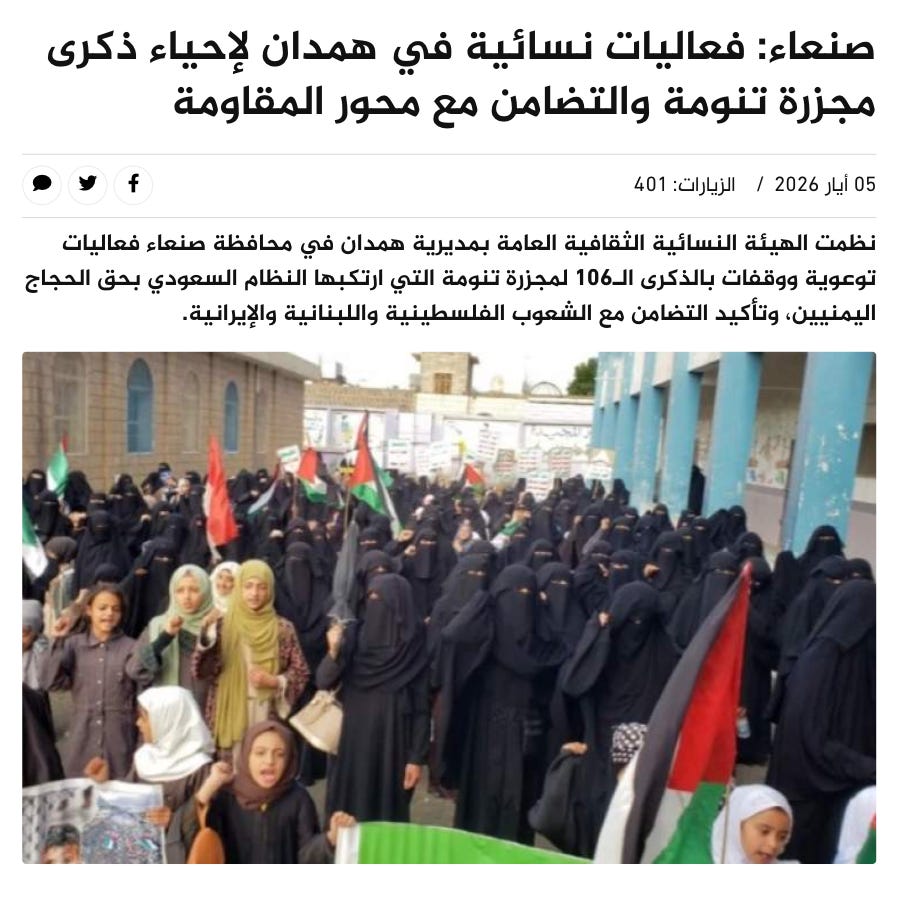
More on this issue was covered in political op-eds such as “The Bad Neighbor and the Black File” published on May 5 which opened the Tanuma chronology and continued through “the Saudi aggression against Yemen and the violation of Yemeni sovereignty in 1934 AD.” “Tanouma: The Deep Wound and the Persistent Hatred” on May 5 connected the 1923 event to the 2015 war and what it described as a continuing siege. “A Century of Saudi Hatred Toward Yemen” on May 4 built the genealogy of “Wahhabi exclusionary ideology” as the British colonial instrument that produced the Saudi state. “Fingerprints of Aggression” variants appeared alongside.
The function of this pressure on Saudi is leverage. As earlier issues of this lane have noted, the Houthi-Saudi back-channel remains active in the background even when not visible in dated headlines. The Tanuma file is positioning for that track. By framing eleven years of war as the latest expression of a century-old Saudi project against Yemen, the campaign argues that current grievances cannot be resolved through ceasefire arrangements alone. They require compensation. Mohammed Al-Fareh’s framing of recent “de-escalation” as cover for continued Saudi intelligence activity sits inside the same posture. So does Abu-Ras’s late-May 4 statement excoriating Riyadh for receiving “Zionist teams.” The deputy foreign minister has not normally been the figure deployed for hard-edged Saudi attacks. His use this week, paired with the Mufti’s Friday tone-setting and the editorial saturation, is the active negotiating posture made public.