Among this week's developments: a NATO summit in Ankara, a state funeral in Tehran, Iranian Revolutionary Guard attacks on shipping in the Strait of Hormuz, a widening Houthi front in Yemen, and the collapse of the Islamabad memorandum of understanding. Read together, they describe what Iran is doing next, and what Russia and China are willing to underwrite.
The NATO summit in Ankara on July 7 and 8 named Russia a long-term threat and pledged Ukraine military assistance for 2026. Russian and Chinese state commentary read the summit as evidence of Western disarray and American decline. From Ankara on July 8, Trump declared the ceasefire and the Islamabad memorandum with Iran over. The announcement followed several days of escalation, with the Iranian Revolutionary Guard firing on commercial vessels transiting the Strait of Hormuz on July 6, and the United States revoking its waiver on Iranian oil and striking targets across southern Iran on July 7, citing Iran’s violation of the memorandum.
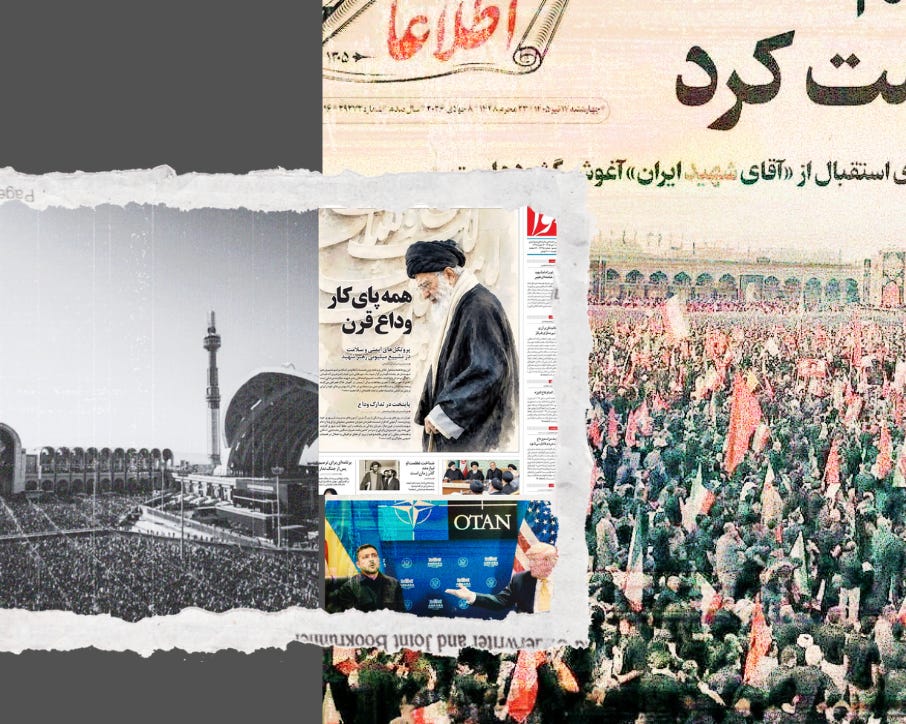
Prior to the escalation, Iran held the state funeral of Ali Khamenei beginning July 3, four months after American and Israeli strikes killed him in Tehran on February 28. The procession moved from the Tehran prayer ground to Qom, then across the border to the Iraqi shrine cities of Najaf and Karbala, and toward Mashhad for burial. Hezbollah, Houthi, and Iraqi militia leadership joined the processions and called the turnout proof of victory over the United States and Israel.
Week in Brief
Russia continued to invest in an image of a weaker Ukraine and a declining United States. Several commentaries described the July 2 Russian strike on Kyiv as punishment rather than retaliation, and coverage of the July 7-8 NATO summit in Ankara framed the alliance as unraveling with Russia as the beneficiary.
Russia, China, Iran, Hezbollah, and the Houthis took particular interest in America’s July 4 250th anniversary to make a case for American decline, drawing on Western press quotes, Chinese academic analysis, Iranian officials, and Houthi opinion pieces.
Iran held a seven-day state funeral for Ali Khamenei from July 3, four months after the American and Israeli strike that killed him on February 28. The state framed the mass turnout as evidence that the order Khamenei led had not been broken by his killing. The procession moved from the Tehran prayer ground to Qom to the Iraqi shrine cities of Najaf and Karbala, with burial planned in Mashhad on July 9.
On the Strait of Hormuz, the Iranian Revolutionary Guard fired on three commercial vessels transiting the strait on July 6 and 7. The United States revoked its sanctions waiver on Iranian oil and, on July 7, CENTCOM struck more than eighty targets in southern Iran. Tehran replied through its parliament speaker and lead negotiator, Mohammad Bagher Ghalibaf, who accused Washington of major violations of the Islamabad memorandum.
The Houthi militia conducted a coordinated escalation across land, sea, and air, timed to the funeral week and to the Iran-US Hormuz confrontation.
Dmitry Medvedev with the Russian delegation before Ali Khamenei's casket in Tehran, July 3, 2026. Iran chose Al-Qasas 28:83 for the Russian approach, praising "those who do not desire exaltedness upon the earth or corruption."
NATO in Ankara, and the argument of Western disarray
Although Russia is not a NATO member and had no seat at the Ankara summit, its state media followed the proceedings closely. Moscow sees itself as the beneficiary of every alliance rift and is keen on conveying this posture through state media as a way to reassure its own public of its eventual resilience. A couple of details were amplified. Trump was quoted saying he “might not have come” to the summit had it been held anywhere but Turkey, offered as evidence that American commitment to the alliance is thinning. The Turkish analyst Nijat Sezgin was cited arguing that Ankara had deliberately sent its culture and tourism minister to receive Zelensky at the airport rather than a foreign policy official, to signal that the visit was protocol, not politically significant. Moscow appeared to relish the framing. And on the Trump-Zelensky meeting itself, Russian state commentary amplified a piece by the Ukrainian outlet Strana.ua, arguing that Trump’s promises about Patriot missile production licenses “look more like informational preparation for negotiations with Moscow than practical steps to support Ukraine.”