

Iran’s indirect talks with Washington moved from Muscat to Geneva in six days, while the IRGC staged a naval exercise it named “Smart Control of the Strait of Hormuz” on the same day Araghchi met Oman’s foreign minister at the InterContinental. Khamenei told Iranians their marches had “uplifted Iran and disappointed the enemy”; two days later in Sana’a, Abdul-Malik al-Houthi warned that the region faces a new normal of occupation, siege, and American impunity. Hezbollah-aligned media ran two separate Epstein investigations in a single week, framing the DOJ files as proof that elite sexual predation was not a scandal but a “side effect of transformations in American capitalism.” And the Munich Security Conference convened under a motto, “Under Destruction,” that Russian state media treated less as self-reflection than as an involuntary confession.
Week in Brief
Ali Larijani, Khamenei's senior advisor and special envoy, traveled to Muscat on Feb 10 for high-level diplomatic engagement, including a meeting with Mohammed Abdulsalam, the Houthis' chief negotiator and head of their negotiating delegation. Oman's foreign minister called the meeting "constructive", while Houthi military media framed the Muscat talks as a "brink of the abyss" test and amplified Larijani's remarks that Washington had chosen the "rational path." Iraq and Kuwait's endorsement of the indirect talks was framed as regional legitimization. By Feb 15, Araghchi departed for Geneva and met Oman's foreign minister there, while Rubio acknowledged a diplomatic opportunity, "difficult but possible." By week's end, the diplomatic track had advanced from Muscat to Geneva with enough regional support to sustain it.
At the annual commemoration of the 1979 Islamic Revolution, pro-government supporters turned out for demonstrations and parades featuring symbolic coffins of U.S. and Israeli military commanders, a direct response to recent American military threats. Iranian hardline media reinforced the message with an article titled "Iran's missile program is a red line", while a separate piece warned that if "wrongdoing occurs under the cover of negotiations, the enemy's interests in the region will be crushed." Major General Abdolrahim Mousavi, Chief of Staff of Iran's Armed Forces, was quoted saying that "a battle with Iran will be a lesson for Trump." By week's end, the IRGC Navy had launched its "Smart Control of the Strait of Hormuz" exercise, with Iranian outlets amplifying warnings that closing Hormuz could collapse the U.S. economy and quoting a former NATO official calling the exercise "a direct message to Washington." Majid Takht-Ravanchi, Iran's Deputy Foreign Minister and lead nuclear negotiator, meanwhile stated that "zero enrichment is not on the table."
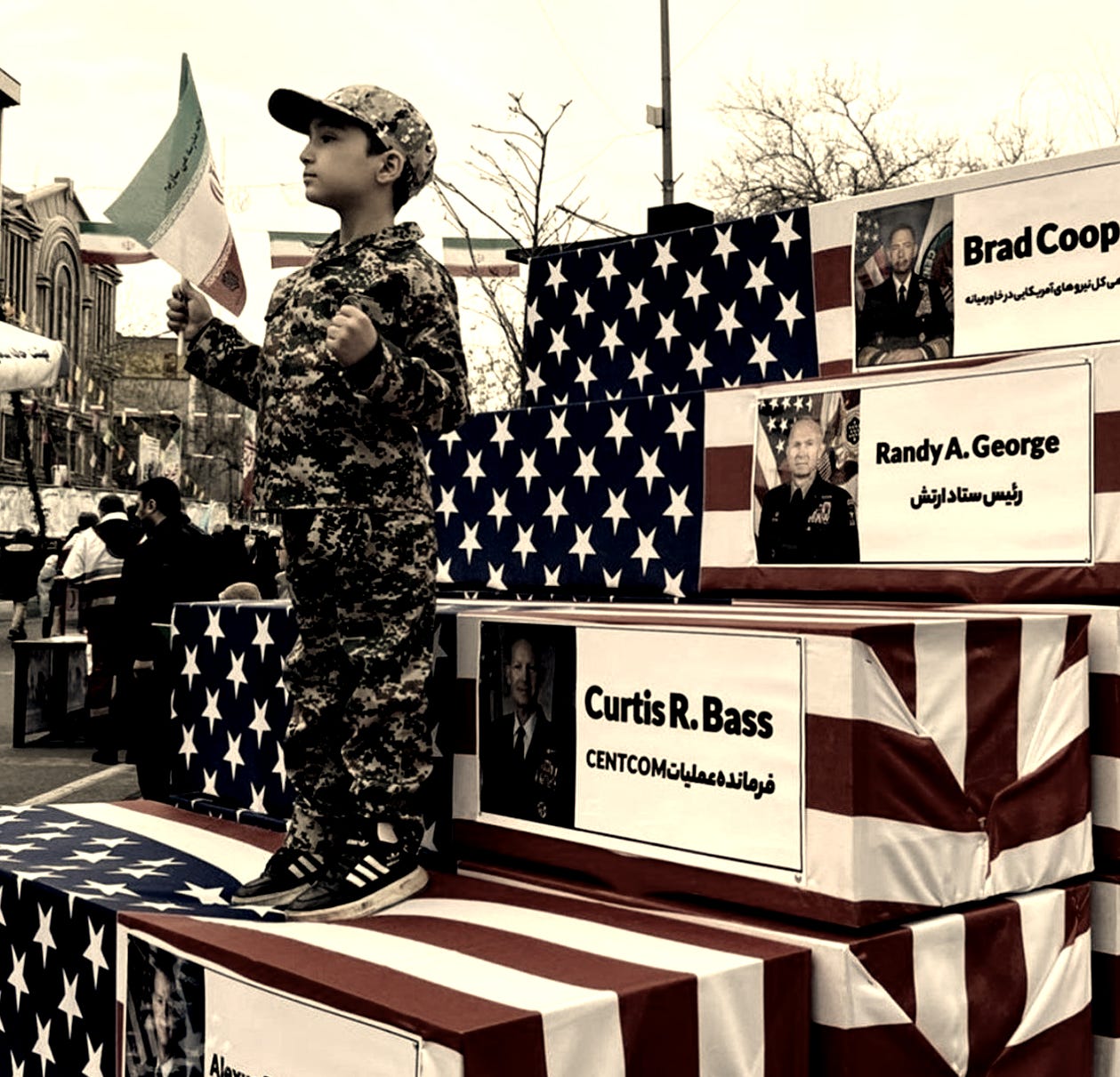
Iranian media used the anniversary turnout to frame national unity, claiming tens of millions were marching and publishing Khamenei's pre-march call for attendance as a mechanism to force "enemy retreat." Khamenei's post-march message closed the loop: "Iran was uplifted and the enemy was disappointed." In Sana'a, Houthi media ran a parallel commemoration: the eleventh anniversary of the U.S. Marines'