

Abbas Araghchi met Vladimir Putin in St. Petersburg on April 27. In Iranian state coverage, it was proof that Tehran is consulting strategically rather than negotiating from a position of weakness. For Russian state coverage, it was the moment Moscow rebranded itself from Iran’s backer to a fundamental mediator that any settlement architecture has to account for. As for Chinese state coverage, it was the orderly diplomatic visual that fits Beijing’s preferred Middle East posture, which is alignment without alignment costs. By the end of the day, the Iranian press had indicated a three-stage negotiating framework: end the war and guarantee no return of fighting against Iran or Lebanon first, settle the Strait of Hormuz second, and only then reopen the nuclear file. Russian and Chinese state outlets carried the framework the same evening, each reframing it for its own audience.
Week in Brief
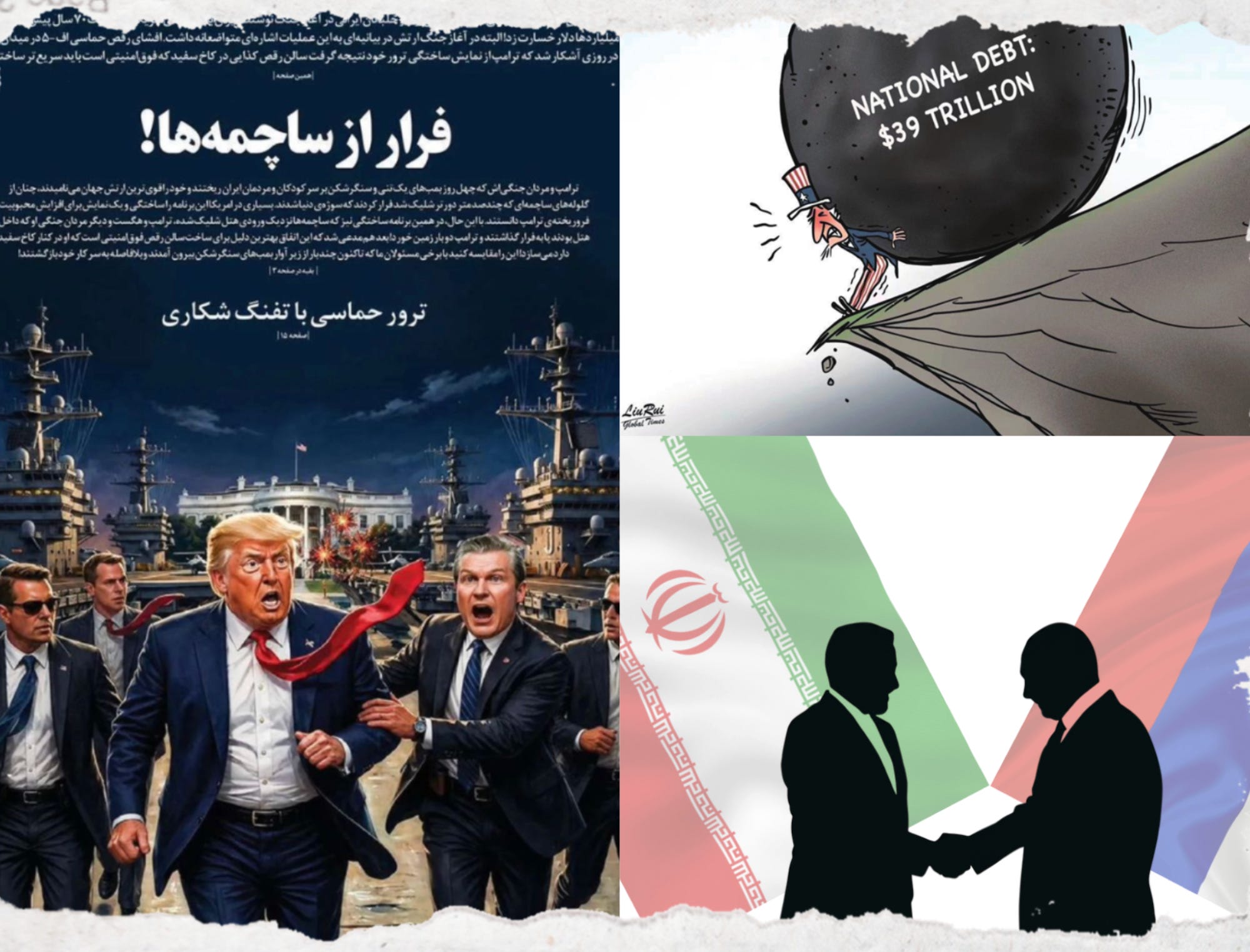
Iranian state coverage treated the negotiation track in Moscow as a Trump retreat dressed in diplomatic language. Iranian commentary opened with the claim that Trump was “seeking through negotiation what he failed to achieve in war,” and parliamentary speaker Mohammad Bagher Ghalibaf’s takeover of the Islamabad-track negotiating team was framed as wartime hardening rather than a softening. At the same time, Iran’s UN envoy was placing legal liability for any Hormuz disruption on Washington and its allies. Hardline commentary sharpened into a claim that “America is the loser of the war and has no right to set conditions” and that Trump and Defense Secretary Pete Hegseth were “humiliated” and “looking for scapegoats.”
Running underneath the diplomatic coverage was a sustained effort to inflate Iranian capability for a domestic audience that has just come through a forty-day war with the United States. Only “part of” Iran’s missile capacity was used in the fighting, the press claimed. Fifteen “American heavy missiles” had been discovered and neutralized inside Hormozgan province on the Iranian Gulf coast. And Hormuz must not return to its prewar state, per a wartime instruction attributed to Mojtaba Khamenei. The argument the press is making to its own readers is that Iran won, that it has reserves it has not even drawn on, and that the Supreme Leader’s circle is personally directing what comes next.
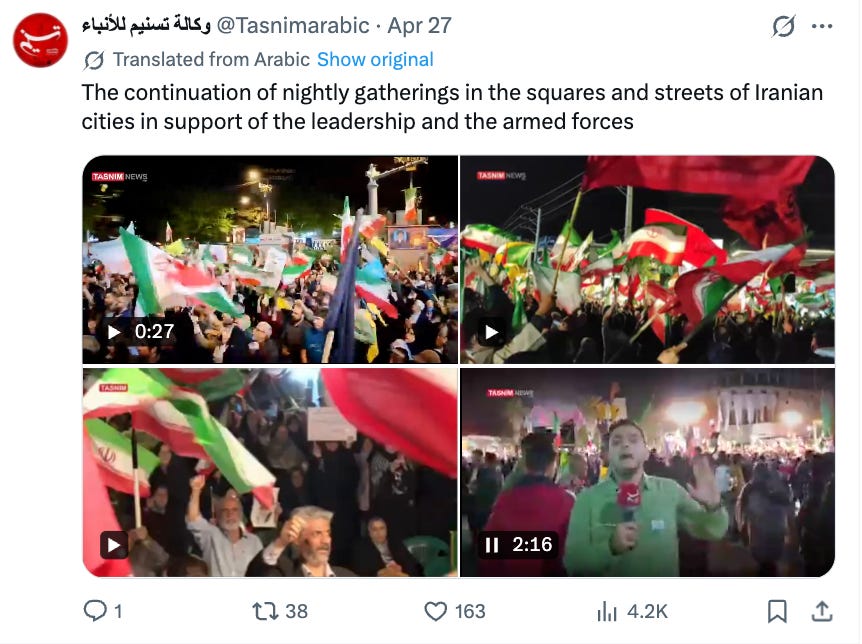
Alongside this, Iranian state media maintained continuous coverage of nightly rallies in Iranian cities, framed as popular support for the leadership and the armed forces. Tasnim Arabic carried footage from Revolution Square in Tehran with the caption “Iran of Imam Reza and the soldiers of Sayyid Mojtaba,” and parallel Persian-language framings across hardline papers connected Mojtaba to the religious legitimacy of Imam Reza. The mobilization apparatus is doing the same domestic-loyalty work the Houthis do with the Sarkha rallies, and the religious-genealogy framing is the same kind of move: locating regime authority in sacred lineage rather than in negotiated outcomes.
Hezbollah-aligned Lebanese coverage documented Israeli strikes in south Lebanon, including the killing of journalist Amal Khalil, and presented Hezbollah drone retaliation as legal response rather than escalation. Coverage delegitimized Lebanese state diplomacy with Israel as either capitulation or, in one banner phrase, a “submissive authority that begs the enemy” (سلطة صاغرة تتوسّل العدو). The language cast the Lebanese state as no longer a sovereign actor but a supplicant. Hezbollah Secretary-General Naim Qassem drew the political line that follows from this. The resistance, he said, is “not bound by the results of the authority’s negotiations.” The same outlets insisted no Iran deal is legitimate that does not include Lebanon as a guaranteed party.
Russian state outlets used the Iran file as evidence of two things their established narrative wants: U.S. military overextension and NATO alliance friction. A Politico report on a White House NATO-contributions list became, in their hands, evidence of a tiered, disciplinary alliance. Trump’s order for the U.S. Navy to fire on vessels laying mines in Hormuz was rendered as escalatory desperation rather than enforcement. Standard battlefield coverage continued at full volume on Ukraine, with the Bockovo capture amplified across the wires. The strongest material concentrated in a set of named-officials items: Rubio admitting Iran retained half its prewar missile arsenal, Rubio calling the straits “the economic equivalent of nuclear weapons,” and former CIA analyst Ray McGovern’s commentary that Vance and Rubio “may turn away from Trump.”
Chinese state coverage is split between cautious official wires and aggressive commentary sites. The state news agency tracked the Pakistan envoy's trip and its subsequent cancellation in close sequence, and ran explainers tying the Lebanon-Israel ceasefire to the U.S.-Iran track. Chinese state-affiliated commentary noted that Trump was “putting on a brave face,” German Chancellor Friedrich Merz quoted as saying “the whole United States has been humiliated by Iran,” NATO considering canceling its 2028 summit to avoid friction with Trump, and a Thai foreign minister saying Bangkok turned to Beijing and Moscow because Washington “did not help at all.”
The Houthis remain focused on extracting ideological loyalty in their territory inside Yemen while Iran carries the diplomatic foreground. Friday rallies for the Sarkha, the movement’s founding chant, spread across multiple governorates, with parallel events in the military regions of Hodeidah and Taiz. Abdul-Malik al-Houthi, the movement’s leader, did not deliver a fresh speech inside this window, and the most senior Houthi voice came through the Sana’a Foreign Ministry’s warning that continued Israeli action against Palestine, Lebanon, and Iran could “drag the region into a wider war.” That register is diplomatic, not military.